
The PRS Database and landlord privacy: what you must give the register, and what the public may see
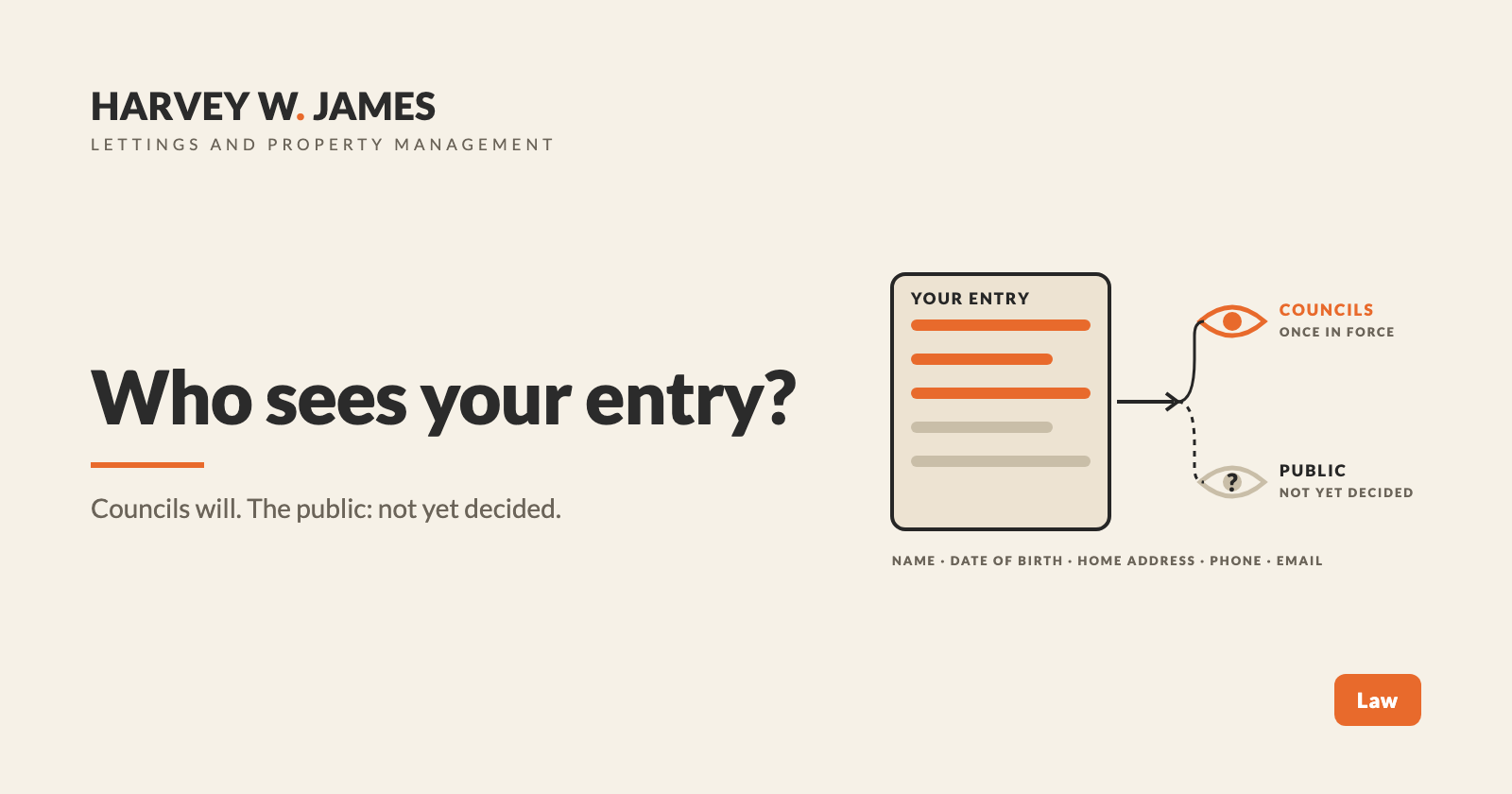
Short answer: On PRS Database and landlord privacy, the draft rules ask for your name, date of birth, home address, phone and email, plus the flat's details, rent and safety certificates. Councils will see the entries. As at 13 November 2026, GOV.UK says nothing is shared publicly, but some details may become public later, under regulations not yet made.
The dates, the £65 fee and the penalties are in our guide to registering your rental property: on the government's announced timetable, London registers between 15 July and 14 October 2027. This post answers the question that guide left open: what you hand over, and who gets to see it. England only, read on legislation.gov.uk and GOV.UK on 13 November 2026.
When will the landlord database start?
The service opens regionally on 15 December 2026 (GOV.UK landlord guidance, published 29 October 2026). The detailed rules are in the Private Rented Sector Database Regulations 2026. On 13 November 2026 legislation.gov.uk still marked them as a draft "and has not yet been made". They are an affirmative instrument, so both Houses of Parliament must approve them first. Everything below from the draft could still change.
What information does the PRS Database hold about a landlord?
Two records: a landlord entry for you and a dwelling entry for each let home (Renters' Rights Act 2025, section 75(2)). The draft sets out the content in Schedules 2 and 3.
Your landlord entry (draft regulation 5 and Schedule 2), if you own as an individual: your name, date of birth, residential address, telephone number and email address. Joint owners each make their own landlord entry and share one dwelling entry (Explanatory Memorandum, paragraph 5.7). If you own through a company, the entry covers the company, but it still records the name, date of birth, email and phone number of the person making the entry, and a nominated contact. Where no Companies House number is given, it also records the names, dates of birth and addresses of all its directors (Schedule 2, paragraphs 11, 12 and 15).
The dwelling entry, Part 1 (Schedule 3): the flat's address; your name, an email address, and a correspondence address in England and Wales that may not be a PO box; ownership type; dwelling type; bedrooms; whether it is let; and the name and email address of the freeholder, any superior landlord and the property manager.
The dwelling entry, Part 2: number of occupants and households; any HMO, additional or selective licence; the gas safety record and its issue date; the EICR and its expiry date, or the EIC; the EPC, where one had to be given; any registered MEES exemption; the rent and how often it is paid; which utilities it includes; and whether the flat is furnished.
For a flat already let, Part 2 can follow the Part 1 registration, but it must be supplied within 28 days of the dwelling entry being made, or the entry becomes inactive (draft regulations 6(2) and 11(2)(a)). Anything that goes out of date must be updated within 28 days of that happening (draft regulations 8 and 9(4)).
PRS Database and landlord privacy: what will the public see?
Not yet decided. Section 86(1)(a) of the Act lets the Secretary of State specify by regulations which information in the entries the operator "is to make available to the public". No such regulations exist. The government's Explanatory Memorandum to the draft says (paragraph 5.3) that a third statutory instrument "will be introduced at a later date" to specify what is made publicly available. Paragraph 5.9 adds that "Key data about the property will be published".
What GOV.UK has said, with dates:
- 9 September 2026 (press release): in the future, "tenants will be able to see whether their landlord or prospective landlord has signed up".
- 29 October 2026 (landlord guidance): "Currently your landlord and property information will not be shared publicly. However, in the future, some information about you and your rental property may be viewable to the public."
| What you give | Draft rule | Councils (once in force) | The public (as at 13 Nov 2026) |
|---|---|---|---|
| Name, date of birth, home address, phone, email | Schedule 2 | Yes, s.86(2) | Not decided: a later SI under s.86 |
| Flat address, bedrooms, type, whether let | Schedule 3 Part 1 | Yes | Not decided; "key data about the property" to be published (EM 5.9) |
| Correspondence address in England and Wales, and email | Schedule 3 Part 1 | Yes | Not decided |
| Rent, occupants, certificates, licences | Schedule 3 Part 2 | Yes | Not decided |
| Whether you are registered | Your active entries | Yes | Signalled by GOV.UK (9 Sep 2026) |
Who will see it, by law. Once the database sections are brought into force (the government says a Commencement No. 4 order will do this), section 86(2) will oblige the operator to give access to lead enforcement authorities, local housing authorities, local weights and measures authorities, mayoral combined authorities and the Greater London Authority. Each will be able to use it only for its housing functions (section 88). Anything not made public that identifies a person will be "restricted information". Knowingly or recklessly disclosing it outside the Act will be an offence (section 87(1) and (6)), and nothing in section 87 overrides data protection law (section 87(5)).
How long it stays. Once section 89 is in force, an entry that has been inactive for five continuous years must be removed (section 89(1)).
Can my letting agent register me on the PRS Database?
Not on their own, unless they hold a formal power. Under draft regulation 4(2), only the landlord can make the entries, or a person in a listed capacity such as a donee of a power of attorney or a court-appointed deputy (Schedule 2, paragraph 17). GOV.UK's agent guidance (29 October 2026) is plain: "Landlords must start all property registrations." Once you have registered a property and named your agent's email, the service sends the agent a link. The agent can then supply and update the Part 2 details: tenancy, rent, licences and certificates (draft regulations 4(5) and 7(2)). You stay responsible if those details are not in within 28 days of the entry being made.
We won't make your entries for you: under the draft rules only you, or someone holding a formal power, can. For landlords we manage, we tell you when your window opens and help with the entries as far as the regulations allow. We will publish our own process once the regulations are made.
Does an overseas landlord need an address in England and Wales for the PRS Database?
Two addresses, two purposes. Your landlord entry asks for your residential address, wherever in the world that is (Schedule 2, paragraph 3). Your dwelling entry asks for a correspondence address in England and Wales, not a PO box (Schedule 3, paragraph 2). The draft does not require that address to be a home you own or live in.
Every landlord of a let home must already give the tenant an address in England and Wales for notices (Landlord and Tenant Act 1987, sections 46(1) and 48(1)). The register adds a second reason to settle which address in England and Wales you use.
Our advice is simple. Assume anything you enter could one day be visible, until the section 86 regulations say otherwise. Keep your home abroad in the landlord entry, where the draft rules ask for it, and give a correspondence address in England and Wales you are content to have attached to the flat.
What is the PRS Database landlord registration fee?
£65 per property per year, not subject to VAT; there is no charge for the landlord entry or for updates (GOV.UK, 29 October 2026). During the rollout the first fee is pro-rated so that nobody pays for days before 15 November 2027. GOV.UK's own worked example: a property registered on 25 June 2027 pays £39.60 for its first year.
What this means for a Property DNA flat
The homes we take on fit our Property DNA: modern London new-builds, most owned by landlords who live abroad. More than half of the landlords we manage for live outside the UK, most in mainland China (Street CRM, 9 September 2026). For them the register is a privacy question first, and our overseas landlords page covers the wider picture.
If you own a London flat from abroad and want to talk through the register, your address in England and Wales and the agent link in your language, speak to the China Desk.
Sources
- The Private Rented Sector Database Regulations 2026 (draft affirmative SI, ISBN 9780348286861): regulations 1, 4–11, Schedules 2 and 3 — legislation.gov.uk data.xml; status "has not yet been made" — contents (read 13 November 2026)
- Explanatory Memorandum to the draft Regulations, paragraphs 5.3, 5.7, 5.9 — legislation.gov.uk PDF
- Renters' Rights Act 2025, sections 75, 77, 82, 86, 87, 88, 89 — legislation.gov.uk (point-in-time 13 November 2026)
- Landlord and Tenant Act 1987, section 48 — legislation.gov.uk
- GOV.UK, "Register your rental property service: guidance for landlords", 29 October 2026 — gov.uk
- GOV.UK, "Register your rental property service: guidance for letting agents and property managers", 29 October 2026 — gov.uk
- GOV.UK, "Register your rental property service: guidance for third parties", 29 October 2026 — gov.uk
- GOV.UK, "Stronger protections and greater confidence for renters", press release, 9 September 2026 — gov.uk
- Harvey W James, Street CRM, 9 September 2026: 58 of 93 landlords with an active tenancy live outside the UK, 46 in mainland China
Speak to the China Desk — /china-desk