
Landlord notice to end a tenancy in 2026: how much notice you must give
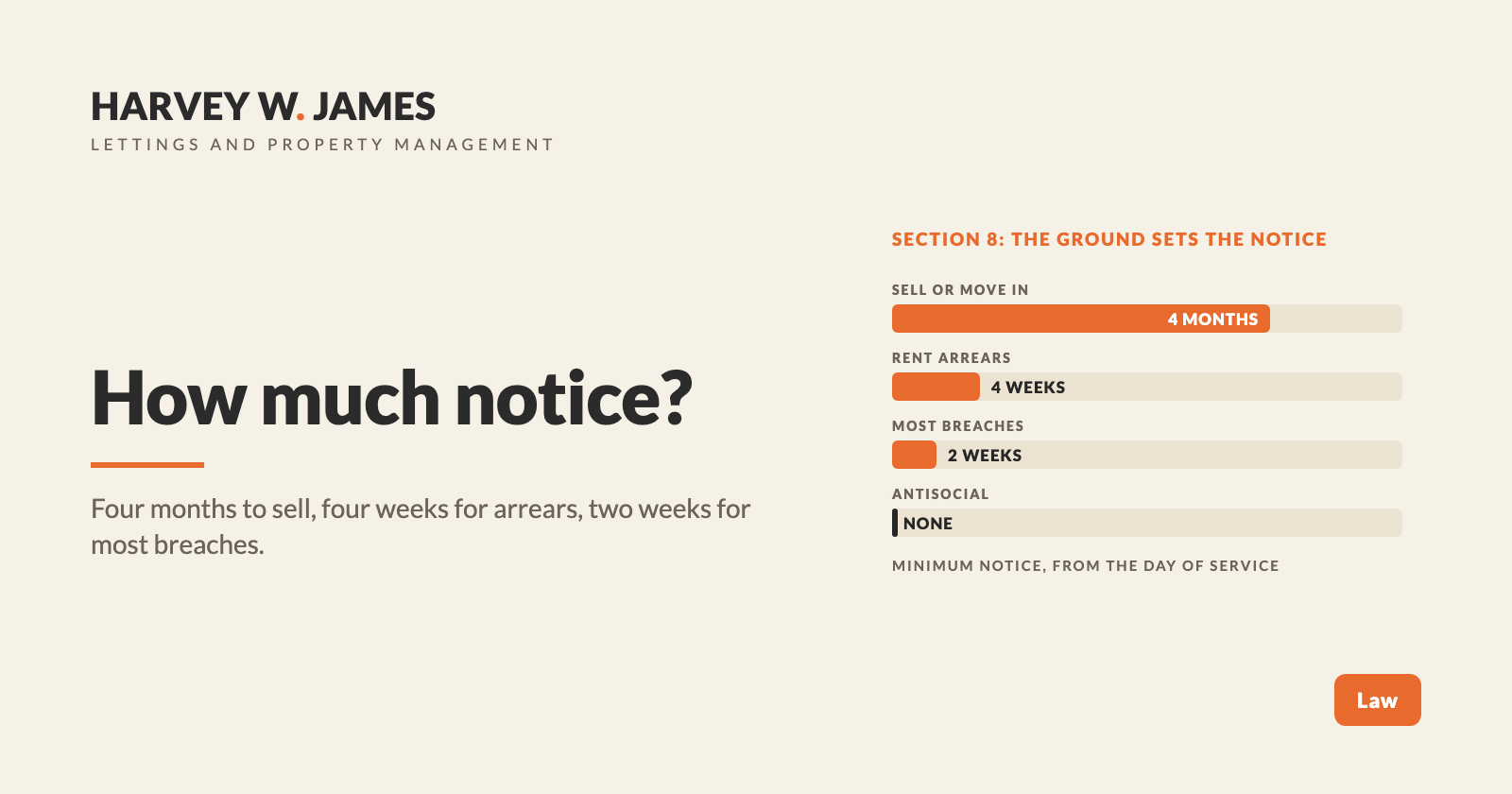
Short answer: For a private assured tenancy in England, a landlord's notice to end a tenancy is now a section 8 notice on Form 3A, naming at least one ground for possession. The ground sets the notice: four months to sell or move in, four weeks for rent arrears, two weeks for most tenancy breaches, and none for antisocial behaviour.
This is the landlord's side. Which grounds exist is in our guide to Section 8 grounds; the tenant's side is in how much notice a tenant has to give. England only, private lets, the law as read on legislation.gov.uk on 10 November 2026.
What is a landlord's notice to end a tenancy now?
Since 1 May 2026, for an assured tenancy, it is a section 8 notice and nothing else. The Renters' Rights Act 2025 omitted the assured shorthold chapter of the Housing Act 1988, section 21 included, for private tenancies from that date (Renters' Rights Act 2025, section 2(b), commenced by SI 2026/421, regulation 2).
Three rules frame the rest:
- The form is prescribed. Section 8(3) of the Housing Act 1988 requires "the prescribed form". For private tenancies that is Form 3A, the version published by the Secretary of State at the time, or a form substantially to the like effect (Assured Tenancies (Private Rented Sector) (Prescribed Forms and Transitional Provisions) (England) Regulations 2026, SI 2026/354, regulation 3(1)(c)).
- The ground must be in the notice. The court cannot order possession on a ground unless that ground and its particulars are specified in the notice (section 8(2)).
- The notice does not end the tenancy. Apart from a narrow right-to-rent exception, a landlord can end an assured tenancy only by a court order for possession that is then executed; a landlord's notice to quit has no effect (section 5(1) and (1A)).
How much notice does a landlord have to give for each ground?
Section 8(4AA) sets a minimum period for every ground, running "beginning with the date of service of the notice". These are the grounds a landlord of a modern London flat is likely to meet.
| Ground | What it covers | Type | Minimum notice |
|---|---|---|---|
| 1 | You or a close family member moving in | Mandatory | 4 months |
| 1A | Selling the home | Mandatory | 4 months |
| 8 | At least 3 months' rent unpaid (monthly rent), at service and at the hearing | Mandatory | 4 weeks |
| 10 | Some rent unpaid | Discretionary | 4 weeks |
| 11 | Persistent late payment | Discretionary | 4 weeks |
| 12 | Breach of a tenancy term other than rent | Discretionary | 2 weeks |
| 13 | Condition of the flat or common parts has deteriorated | Discretionary | 2 weeks |
| 15 | Damage to furniture you provided | Discretionary | 2 weeks |
| 17 | Tenancy granted because of a false statement by the tenant | Discretionary | 2 weeks |
| 14 | Nuisance, annoyance, or certain convictions | Discretionary | None: the date can be the day of service |
Mandatory means the court must order possession if the ground is proved (section 7(3)). Discretionary means it may, if it considers it reasonable (section 7(4)).
Citing more than one ground? The date in the notice must not be before the end of the longest period for any ground you name (section 8(4AA)). Ground 8 with Ground 12 is a four-week notice. The exception is Ground 14, or Ground 7A (serious antisocial behaviour): if either is named, the date need not be later than the day of service, whatever else is cited (section 8(4)).
Can a landlord give two months' notice?
Not in the way most landlords mean it: the two-month "no reason" notice has gone. A two-month period survives only for a group of specialist grounds (5 to 5D, 5H, 7 and 9), such as a tenancy that passed under a former tenant's will or intestacy (Ground 7) or suitable alternative accommodation (Ground 9). For selling or moving in, the answer is four months.
When can a landlord serve notice to sell or move in?
At any time, but the date in the notice cannot fall within the tenancy's first year. Grounds 1 and 1A both require that the current tenancy "began at least 1 year before the relevant date", and for these grounds the relevant date is the date specified in the notice (Schedule 2, paragraph 12(1)). GOV.UK's guidance gives the practical effect: you can serve during the first 12 months, but the notice cannot expire before they end, so you may need to give more than four months.
The rest of these two grounds, including the ban on re-letting afterwards, is in our Grounds 1 and 1A article.
How long is a section 8 notice valid?
The notice sets two limits. Proceedings cannot begin before the date in the notice, and they cannot begin later than 12 months from the date of service (section 8(3)(b) and (c)). Miss that window and the notice is spent; you would need to serve again.
If the tenant has not left by the date in the notice, the next step is a court claim. GOV.UK says the online Possession Claim Online service is for rent-only claims and the paper route for other grounds, and that you will need to show the court a copy of the notice and that you gave it correctly, with the right amount of notice.
Two further points. The court has a general power to dispense with the notice where it is just and equitable, but not for Ground 8 (section 8(1)(b) and (5)). And where a deposit was taken, the court can make a possession order only if the deposit is protected and the prescribed information was given, unless the order is on Ground 7A or 14 (Housing Act 2004, section 215(1) to (4)).
What can a landlord no longer do under the Renters' Rights Act?
Section 16E(1) of the Housing Act 1988 includes these things a landlord, or anyone acting for one, must not do:
- grant a fixed term (section 4A makes fixed-term terms of no effect; the tenancy runs as periodic);
- try to end the tenancy with a notice to quit, or orally;
- serve a "purported notice of possession", meaning any written document that claims to end the tenancy but does not comply with section 8 (definition in section 16M);
- rely on a ground without reasonably believing a possession order may be obtained on it.
A local council can fine a landlord up to £7,000 for these breaches (section 16I). For the last one, the fine applies where the tenant surrendered the tenancy within four months of the breach, without a possession order.
So there is no fixed term to run out and no break clause to trigger.
What this means for a new-build flat you own from abroad
Most of our landlords live outside the UK, and our model is built around modern flats in managed blocks. Three practical points:
- Plan a sale at least four months out, and further if the tenancy is under a year old at the date you would want in the notice.
- Keep the evidence from day one. Rent ledger, inventory, deposit certificate and correspondence are what turn a ground into an order.
- Know the date of service. Every period runs from it, so it has to be provable.
On the homes we manage, we prepare and serve section 8 notices on the landlord's instructions, checking the ground, the dates and the deposit position first. We won't put a ground on a notice to apply pressure. If we do not believe a ground can be proved, we say so before anything is served; section 16E(1)(e) now makes that the law.
Our 10% management fee is explained in our Property DNA; separately priced items, such as serving a notice by hand, are listed in our Essential Terms & Fees. The homes we built this for are in new-build specialists.
The Housing Act 1988 is still being amended. Check the current text on legislation.gov.uk before you serve anything.
Sources
- Housing Act 1988, section 8 (s.8(1), (2), (3), (4), (4AA), (5)), as at 10 November 2026 — https://www.legislation.gov.uk/ukpga/1988/50/section/8/2026-11-10
- Housing Act 1988, Schedule 2 (Grounds 1, 1A, 7, 8, 9, 10–15, 17; Part 5 paragraph 12(1) "relevant date"), as at 10 November 2026 — https://www.legislation.gov.uk/ukpga/1988/50/schedule/2/2026-11-10
- Housing Act 1988, sections 4A, 5 and 7, as at 10 November 2026 — https://www.legislation.gov.uk/ukpga/1988/50/section/4A/2026-11-10 , https://www.legislation.gov.uk/ukpga/1988/50/section/5/2026-11-10 , https://www.legislation.gov.uk/ukpga/1988/50/section/7/2026-11-10
- Housing Act 1988, sections 16E, 16I and 16M, as at 10 November 2026 — https://www.legislation.gov.uk/ukpga/1988/50/section/16E/2026-11-10 (and /16I, /16M)
- Housing Act 1988, section 21 (Part 1 Chapter 2 omitted 1 May 2026 by Renters' Rights Act 2025 s.2(b)) — https://www.legislation.gov.uk/ukpga/1988/50/section/21/2026-11-10
- Housing Act 2004, section 215, as at 10 November 2026 — https://www.legislation.gov.uk/ukpga/2004/34/section/215/2026-11-10
- The Renters' Rights Act 2025 (Commencement No. 2 and Transitional and Saving Provisions) Regulations 2026, SI 2026/421, regulation 2 — https://www.legislation.gov.uk/uksi/2026/421/regulation/2/made
- The Assured Tenancies (Private Rented Sector) (Prescribed Forms and Transitional Provisions) (England) Regulations 2026, SI 2026/354, regulation 3 — https://www.legislation.gov.uk/uksi/2026/354/made
- Assured tenancy forms (Form 3A), GOV.UK, updated 1 May 2026 — https://www.gov.uk/guidance/assured-tenancy-forms
- Repossessing your privately rented property after 1 May 2026, GOV.UK, updated 13 July 2026 — https://www.gov.uk/guidance/repossessing-your-privately-rented-property-after-1-may-2026
- Grounds for possession: guidance for landlords and letting agents, GOV.UK, updated 1 May 2026 — https://www.gov.uk/government/publications/grounds-for-possession-guidance-for-landlords-and-letting-agents/grounds-for-possession-guidance-for-landlords-and-letting-agents
Deciding whether to sell, move back in or keep letting? Book a free new-build rental appraisal and we will show you what the flat earns as a let before you serve anything.