
Selling or moving back in: Grounds 1 and 1A after the Renters' Rights Act
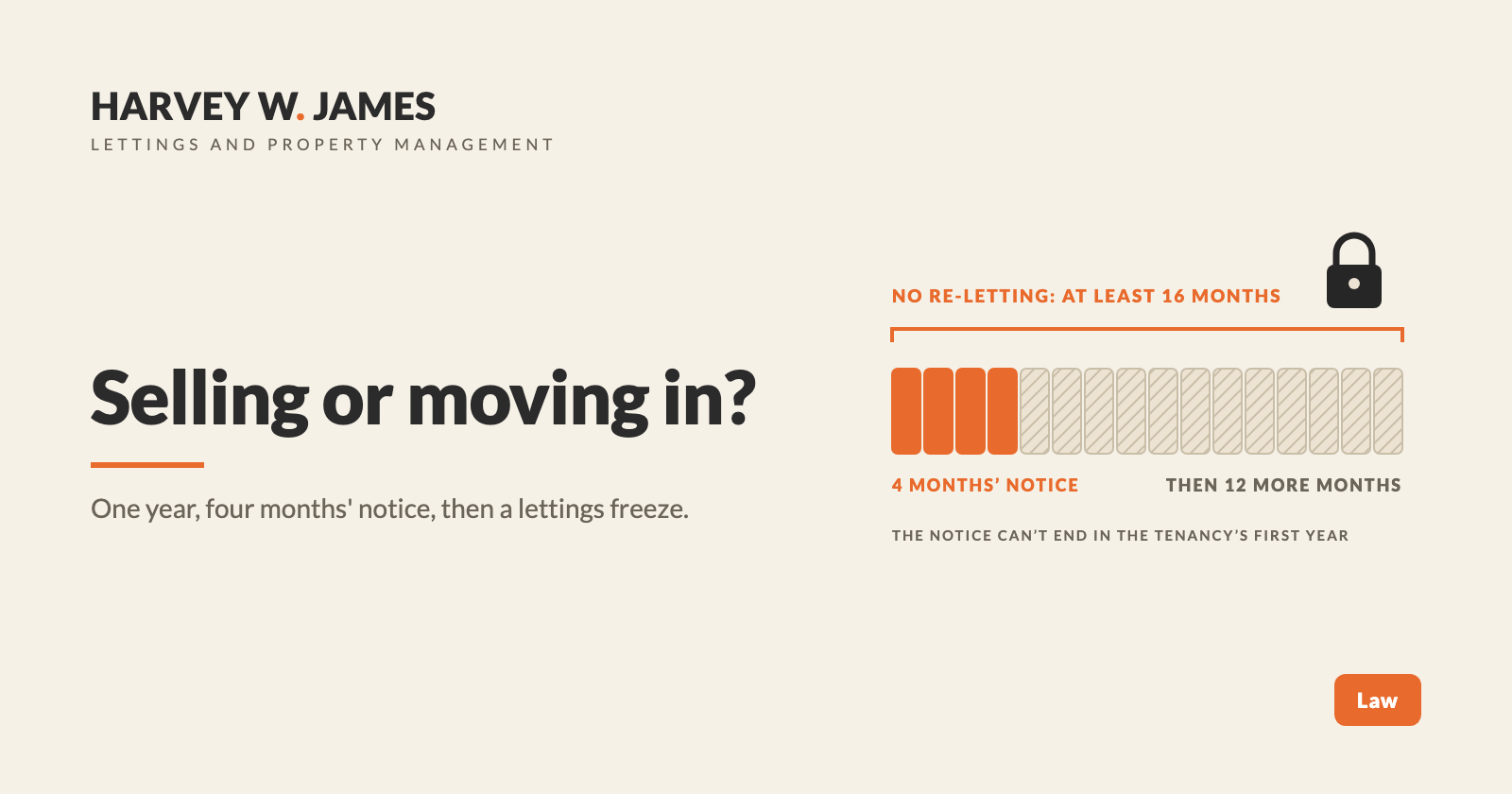
Short answer: Ground 1 recovers a let home for you or a close family member to live in; Ground 1A recovers it to sell. Both are mandatory, need four months' notice and cannot bite in the tenancy's first year. Rely on either and, subject to narrow exceptions, you cannot re-let or market the home to let for at least 16 months.
Every ground is summarised on our Section 8 grounds page and in our August article on Section 8. Here we go deeper on Grounds 1 and 1A only, with every section read on legislation.gov.uk as at 30 October 2026.
When can a landlord use Ground 1 to move back in?
Ground 1 (Schedule 2 to the Housing Act 1988, substituted by Schedule 1 paragraph 2 of the Renters' Rights Act 2025) applies where you require the home as the only or principal home of:
- you;
- your spouse or civil partner, or a person you live with as if married or in a civil partnership;
- your parent, grandparent, sibling, child or grandchild;
- a child or grandchild of your spouse, civil partner or partner.
With joint landlords, the need can relate to any one of them. A second home or an occasional base does not qualify.
The old Ground 1 needed a written warning at the start of the tenancy, and either prior occupation or that the landlord had not bought it already let. The new wording needs none of them, so an investor who has never lived in the flat can use it.
When can a landlord use Ground 1A to sell?
Ground 1A (inserted by Schedule 1 paragraph 3 of the 2025 Act) applies where you intend to sell your freehold or leasehold interest, or to grant a lease of more than 21 years that cannot be ended early by notice. Two exclusions matter to private landlords:
- Pre-1 May 2026 "lifetime" tenancies. Regulation 5 of SI 2026/421 disapplies Ground 1A for an assured tenancy entered into before 1 May 2026 that was not a shorthold immediately before that date. Ordinary shorthold tenancies are unaffected.
- Rent Act successions. It does not apply where the tenancy arose by succession under Schedule 1 to the Rent Act 1977.
You only need Ground 1A if you want the home empty. Selling a flat with the tenant in place involves no possession ground at all.
How does the 12-month protected period actually work?
Both grounds require that "the current tenancy began at least 1 year before the relevant date". For these grounds, the relevant date is the date in the Section 8 notice as the earliest date proceedings can begin (Schedule 2, paragraph 12), and both that day and the tenancy's first day count.
So the test is the notice's date, not the day you serve it. GOV.UK puts it plainly: you can serve in the first 12 months, but the notice cannot expire before they end. Serve four months into the tenancy and the notice must run for eight months.
Most tenancies that began before 1 May 2026 simply continued on that date as assured periodic tenancies (section 146 of the 2025 Act), so many are already well past a year. Where a tenant has held more than one agreement with you, take advice on which is "the current tenancy" before dating the notice.
What notice does each ground need?
Four months, beginning with the date of service, under the table in section 8(4AA). Where a notice cites several grounds, the longest period applies (Grounds 7A and 14 have their own rules). Proceedings must begin within 12 months of service (section 8(3)(c)).
Both grounds are mandatory. If the court is satisfied the ground is made out, section 7(3) says it shall order possession, and section 9(6) removes its general power to adjourn or suspend.
What stops you re-letting after using Ground 1 or 1A?
This is the part most landlords miss. Once a landlord or agent relies on Ground 1 or 1A, section 16E(2) and (3) of the Housing Act 1988 (inserted by section 13 of the 2025 Act) apply for "the restricted period":
- the landlord must not let the home on a tenancy of 21 years or less, or license it for money;
- neither the landlord nor anyone acting for them may market it for either, or authorise anyone else to.
Under section 16M(4), the period starts when the notice is served and ends on the last day of the 12 months beginning with the earliest proceedings date in the notice. That is at least 16 months. It runs whether or not the tenant leaves (section 16E(4)) and ends early only if the court orders possession on another ground (section 16M(7)).
| Ground 1 (moving in) | Ground 1A (selling) | |
|---|---|---|
| Who or what | You or a listed close family member, as only or principal home | Sale of your freehold or leasehold, or a lease over 21 years |
| Tenancy age | At least 1 year at the date in the notice | At least 1 year at the date in the notice |
| Notice | 4 months | 4 months |
| Excluded tenancies | None for ordinary private lets | Pre-1 May 2026 non-shorthold assured; Rent Act successions |
| Re-letting ban | From service of the notice to the end of 12 months from the date in the notice | Same |
| Main exception (s.16F) | You or a listed relative lives there | Licence to a buyer, or to a person taking a lease over 21 years, ahead of completion |
Shared owners have a further exception (section 16F(3) to (5)) that depends on a written statement given in advance; for tenancies running on 1 May 2026, the window closed one month later (SI 2026/421, regulation 9).
Breaching the ban is an offence (section 16J(2)). A council may impose a penalty of up to £40,000 instead of prosecuting (section 16K), and it is a rent repayment order offence (Housing and Planning Act 2016, section 40). Relying on a ground you do not reasonably believe can succeed is a separate breach (section 16E(1)(e)).
What evidence should you have before serving?
The statute lists no documents; the court must be satisfied of the need or the intention. Before serving, we would want on file:
- Ground 1: who is moving in, proof of the relationship, and why this will be their only or principal home.
- Ground 1A: the sale plan in writing, such as a selling agent's instruction or a valuation for sale.
- Both: the tenancy start date, and proof the deposit is protected. GOV.UK confirms the court cannot make a possession order otherwise.
Does the Private Rented Sector Database affect Ground 1 or 1A?
It will, once commenced. Section 90 of the 2025 Act inserts section 7(5ZC): no possession order while the landlord is in breach of the database duty, except on Ground 7A or 14. It is not yet in force at 30 October 2026; see our PRS Database article.
What does this mean for a new-build flat you might sell?
Plan the exit when you plan the first let. A vacant sale needs a tenancy at least a year old at the date in the notice, four months' notice and a real sale plan. If the sale falls through, the flat cannot return to the lettings market until the restricted period ends.
We won't market a flat for let while a Ground 1 or 1A restricted period is running, even if asked: the ban binds agents as well as owners. On the homes we manage, we prepare and serve Section 8 notices on the landlord's instructions, checking the date and the ground first. For arrears, see our Ground 8 guide.
The Housing Act 1988 is still being amended. Check the current text on legislation.gov.uk before you serve anything.
Sources
- Housing Act 1988, Schedule 2 (Grounds 1 and 1A; paragraph 12 "relevant date"), as at 30 October 2026 — https://www.legislation.gov.uk/ukpga/1988/50/schedule/2/2026-10-30
- Housing Act 1988, section 8 (s.8(3)(c), (4AA) table), as at 30 October 2026 — https://www.legislation.gov.uk/ukpga/1988/50/section/8/2026-10-30
- Housing Act 1988, sections 7(3) and 9(6), as at 30 October 2026 — https://www.legislation.gov.uk/ukpga/1988/50/section/7/2026-10-30 and https://www.legislation.gov.uk/ukpga/1988/50/section/9/2026-10-30
- Housing Act 1988, sections 16E, 16F, 16G, 16I, 16J, 16K and 16M, as at 30 October 2026 — https://www.legislation.gov.uk/ukpga/1988/50/section/16E/2026-10-30 (and /16F, /16G, /16I, /16J, /16K, /16M)
- Housing and Planning Act 2016, section 40 (rent repayment order offences), as at 30 October 2026 — https://www.legislation.gov.uk/ukpga/2016/22/section/40/2026-10-30
- Renters' Rights Act 2025, section 90 (inserting HA 1988 s.7(5ZC)) and section 146 (existing tenancies) — https://www.legislation.gov.uk/ukpga/2025/26/section/90/2026-10-30 and https://www.legislation.gov.uk/ukpga/2025/26/section/146/2026-10-30
- Renters' Rights Act 2025 (Commencement No. 2 and Transitional and Saving Provisions) Regulations 2026, SI 2026/421, regulations 2, 5 and 9 — https://www.legislation.gov.uk/uksi/2026/421
- Grounds for possession: guidance for landlords and letting agents, GOV.UK (last updated 1 May 2026) — https://www.gov.uk/government/publications/grounds-for-possession-guidance-for-landlords-and-letting-agents/grounds-for-possession-guidance-for-landlords-and-letting-agents
- Enforcement measures for landlords: Renters' Rights Act 2025, GOV.UK (last updated 1 May 2026) — https://www.gov.uk/guidance/enforcement-measures-for-landlords-renters-rights-act-2025
Weighing up whether to sell, move in or keep letting? Book a free new-build rental appraisal and we will show you what the flat earns as a let, so you decide with the numbers in front of you.