
Rent arrears after the Renters' Rights Act: Ground 8, the three-month test and what to do first
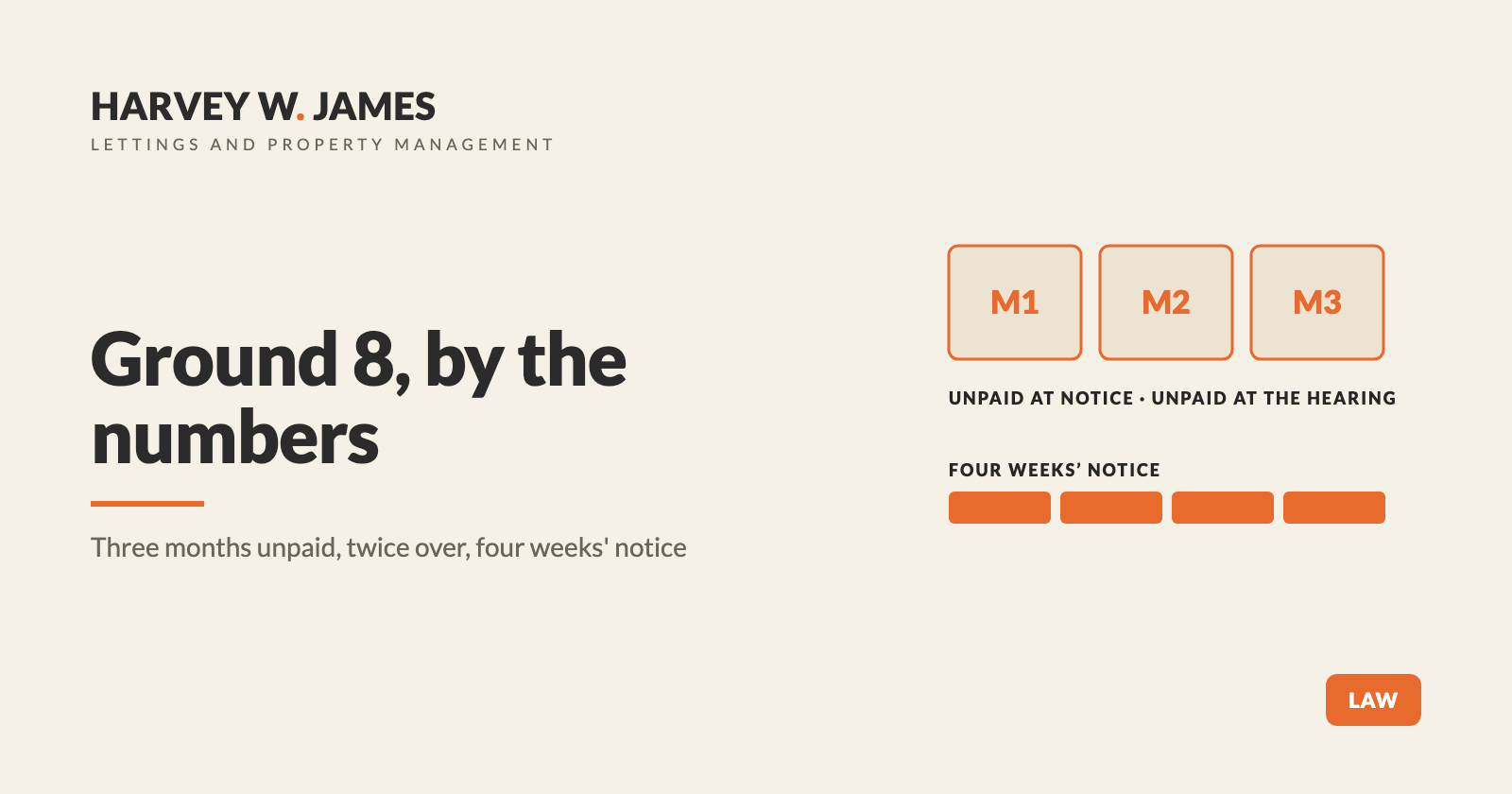
Short answer: Ground 8 is the mandatory rent-arrears ground. Since 1 May 2026 it needs three months' rent unpaid (13 weeks' if rent is weekly or fortnightly) both when the Section 8 notice is served and at the hearing. Notice is four weeks. Below that, Grounds 10 and 11 apply and the court decides.
This is the arrears piece. Every ground and its notice period is on our Section 8 grounds reference page, and the grounds a London landlord realistically uses are in our August article on Section 8. Here we cover the three arrears grounds only: what each requires, what counts, what to do before serving, and how we run arrears on the homes we manage. Every section cited was read on legislation.gov.uk as at September 2026.
What does Ground 8 require after the Renters' Rights Act?
Ground 8 sits in Schedule 2 to the Housing Act 1988, as amended by Schedule 1 paragraph 24 of the Renters' Rights Act 2025. The Act raised the threshold from two months to three for monthly rent, and from eight weeks to 13 for weekly or fortnightly rent.
The test has to be met twice: at the date the notice is served and at the date of the hearing. Prove it and section 7(3) says the court shall make an order for possession. Section 9(6) also switches off section 9's power to adjourn, suspend or postpone where the landlord is entitled to possession on a mandatory ground. That certainty is what Ground 8 is for.
The notice period is four weeks from service (section 8(4AA)). The court cannot waive the notice on Ground 8 (section 8(5)). Proceedings must begin no later than 12 months after the notice is served (section 8(3)(c)).
What counts as rent arrears for Ground 8?
Rent only. Schedule 2 defines "rent" for Ground 8 as rent lawfully due from the tenant. Late-payment interest, cleaning and damage charges are not rent and do not count towards the threshold.
Ground 8 counts money, not days. Where rent is due monthly in advance, the third missed payment takes the ledger to three months' rent on the day it falls due. The reverse also holds: a part payment that brings the balance below three months by the hearing defeats Ground 8 outright.
Universal Credit has its own rule. When calculating the arrears, any amount unpaid only because a tenant entitled to Universal Credit housing costs had not yet received that payment is ignored. Government guidance for landlords explains why that gap appears: Universal Credit is paid monthly in arrears, and the first payment usually arrives one month and seven days after the claim.
When do Grounds 10 and 11 apply?
Ground 10 needs some rent lawfully due to be unpaid when proceedings begin, and to have been in arrears when the notice was served. Ground 11 needs a persistent delay in paying rent, whether or not anything is owed on the day proceedings begin.
Both are discretionary. The court may order possession only if it considers it reasonable (section 7(4)). If it adjourns or suspends instead, section 9(3) requires it to set conditions on paying the arrears and the rent, unless that would cause exceptional hardship to the tenant or would otherwise be unreasonable.
All three grounds carry the same four-week notice, so citing them together costs nothing in time.
| Ground | Type | The test | When it must be met | Notice | What the court does |
|---|---|---|---|---|---|
| 8 | Mandatory | At least 3 months' rent unpaid (13 weeks if weekly or fortnightly), ignoring Universal Credit timing gaps | At service and at the hearing | 4 weeks; cannot be waived | Must order possession if proved; no adjournment or suspension under section 9 |
| 10 | Discretionary | Some rent lawfully due is unpaid | When proceedings begin, and in arrears at service | 4 weeks | May order possession if reasonable; can suspend on payment conditions |
| 11 | Discretionary | Persistent delay in paying rent | Whether or not anything is owed when proceedings begin | 4 weeks | As Ground 10 |
What should a landlord do before serving a Section 8 notice?
Get the ledger exact. The notice must specify the ground and its particulars (section 8(2)). List each due date, each amount due and each payment received.
Check the deposit. Under section 215 of the Housing Act 2004, as substituted by the Renters' Rights Act 2025, the court may make a possession order only if the deposit is held in an authorised scheme, the scheme's requirements were met and the tenant was given the prescribed information (section 215(1) to (3)). An unprotected deposit has to be put right first.
Ask about benefits. If the tenant claims Universal Credit, you can apply for a managed payment, which pays their housing costs straight to you. GOV.UK presents it as an alternative to eviction.
Check for a breathing space. During a Breathing Space moratorium under the Debt Respite Scheme regulations of 2020, a landlord may not serve a possession notice on Grounds 8, 10 or 11 for the debt, take possession having served one, start legal proceedings over it, or require interest that accrues on it during the moratorium (regulation 7(6) and (7)).
Use the right form. A private-sector Section 8 notice is Form 3A. Keep proof of service, such as the N215 certificate of service.
How does the court route work?
If the tenant does not leave when the notice expires, you apply for a possession order. For a rent-arrears claim GOV.UK points to Possession Claim Online; other standard claims use forms N5 and N119. If the tenant does not leave after an order, you apply for a warrant of possession, which court bailiffs carry out. How long each stage takes depends on the court. We do not publish a figure we cannot source. If the tenant disputes the arrears, take advice from a housing solicitor before the hearing.
How do we handle rent arrears on the homes we manage?
Section 70 of our Essential Terms and Charges (v2.3.0, issued 18 September 2026) sets the process:
- Days 1 and 3: automated reminders to the tenant by text and email.
- Day 7: our team contacts the tenant directly.
- Day 14: a further written reminder. Interest under section 42.7 may run from here, at 3% above Bank of England base rate and never before rent is more than 14 days late. That is the ceiling the Tenant Fees Act 2019 allows (Schedule 1, paragraph 4).
- Days 21 to 28: a formal arrears letter on your behalf, and your Rent Protection insurer notified where a policy is in place.
- Then, on your instruction: a Section 8 notice, citing Grounds 10 and/or 11 first and Ground 8 once three months' rent is unpaid.
Where a tenant agrees a repayment plan, we document it (section 70.1). Where Rent Guarantee cover is in place, we start the claim and the insurer takes over the case. Where it is not, we help you instruct an eviction specialist; legal and court fees are yours and may be claimed from the tenant.
We won't let a missed payment sit unreported. Rent is reconciled daily, and a missed payment is flagged to us and to you within one working day (section 70). That matters most to owners abroad: 58 of the 93 landlords with an active tenancy with us live outside the UK (measured 9 September 2026). See how we work for overseas landlords.
Further changes to the Housing Act 1988 may still come into force. Check the current text on legislation.gov.uk before you serve anything.
Sources
- Housing Act 1988, Schedule 2 (Grounds 8, 10 and 11), as at 1 May 2026, re-checked as at 30 September 2026 — https://www.legislation.gov.uk/ukpga/1988/50/schedule/2/2026-05-01
- Housing Act 1988, section 8 (notice; s.8(2), (3)(c), (4AA), (5)), as at 1 May 2026 — https://www.legislation.gov.uk/ukpga/1988/50/section/8/2026-05-01
- Housing Act 1988, section 7 (orders for possession; s.7(3), (4)), as at 1 May 2026 — https://www.legislation.gov.uk/ukpga/1988/50/section/7/2026-05-01
- Housing Act 1988, section 9 (extended discretion; s.9(3), (6)), as at 1 May 2026 — https://www.legislation.gov.uk/ukpga/1988/50/section/9/2026-05-01
- Housing Act 2004, section 215 (deposit sanctions), as at 1 May 2026 — https://www.legislation.gov.uk/ukpga/2004/34/section/215/2026-05-01
- Tenant Fees Act 2019, Schedule 1 paragraph 4 (payment in the event of a default), as at 30 September 2026 — https://www.legislation.gov.uk/ukpga/2019/4/schedule/1/2026-09-30
- Debt Respite Scheme (Breathing Space Moratorium and Mental Health Crisis Moratorium) (England and Wales) Regulations 2020, regulation 7(6) and (7) (unamended since 2022) — https://www.legislation.gov.uk/uksi/2020/1311/regulation/7
- Grounds for possession: guidance for landlords and letting agents, GOV.UK (updated 1 May 2026) — https://www.gov.uk/government/publications/grounds-for-possession-guidance-for-landlords-and-letting-agents/grounds-for-possession-guidance-for-landlords-and-letting-agents
- Universal Credit and rented housing: guide for landlords, GOV.UK — https://www.gov.uk/government/publications/universal-credit-and-landlords/universal-credit-and-rented-housing-guide-for-landlords
- Evicting tenants in England: giving notice, and standard possession orders, GOV.UK — https://www.gov.uk/evicting-tenants/giving-notice-to-evict-tenants and https://www.gov.uk/evicting-tenants/standard-possession-orders
- Harvey W James, Essential Terms and Charges v2.3.0 (issued 18 September 2026), sections 42.7, 70 and 70.1
A tenant behind on rent, or a tenancy you want set up so it never gets there? Book a free rental appraisal and we will talk you through where you stand.