
Register your rental property: the PRS Database dates for London landlords, the £65 fee and what happens if you don't
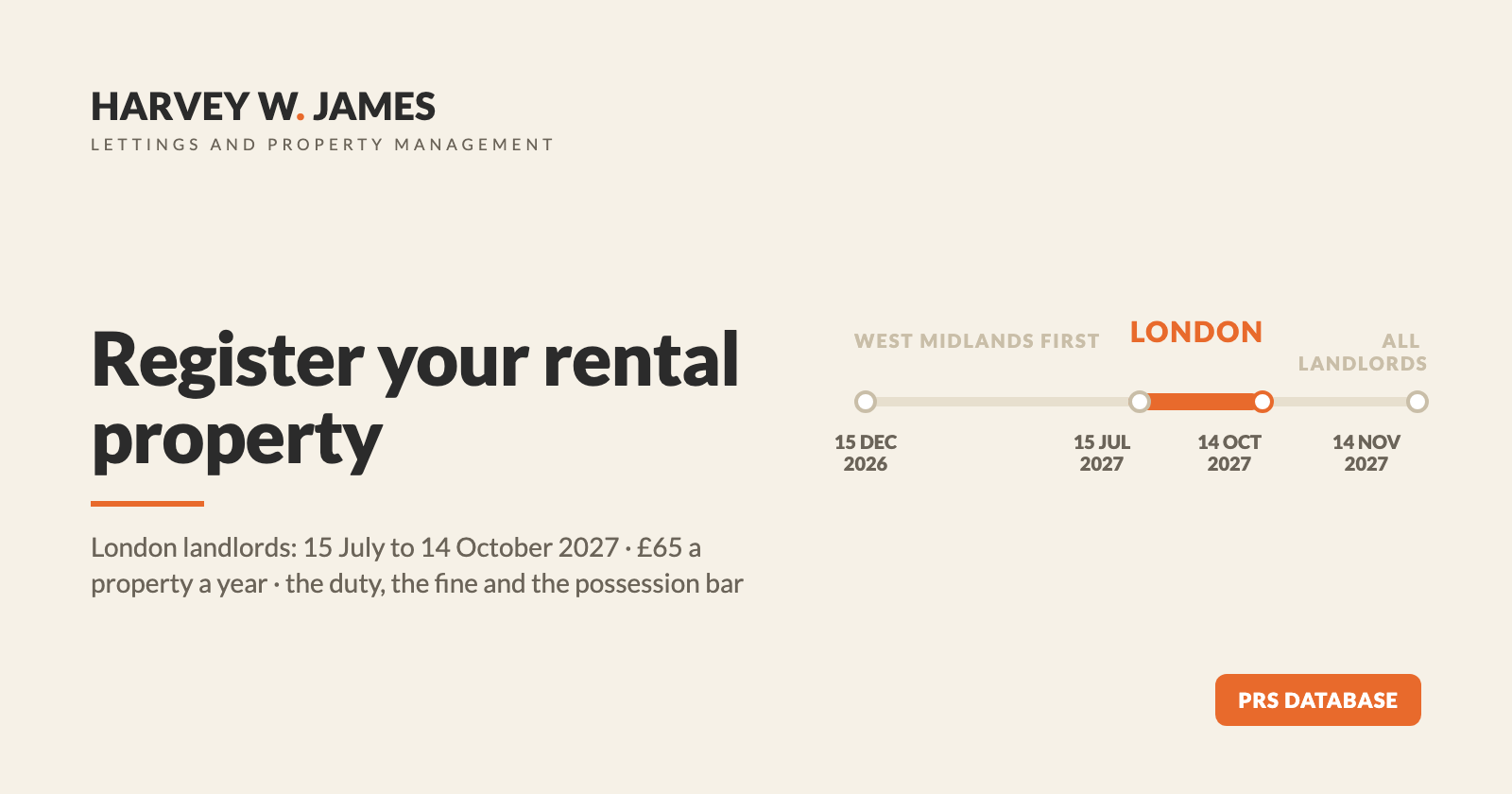
Short answer: every private landlord in England will have to register themselves and each let property on the new Private Rented Sector Database. GOV.UK announced the dates on 9 September 2026: the "Register your rental property" service opens on 15 December 2026 in the West Midlands and works through the regions over twelve months. London's window is 15 July 2027 to 14 October 2027, and every landlord actively letting must be registered by 14 November 2027. The fee is £65 per property per year. Once your region's date has passed, a property cannot be marketed without an active entry, a council can fine you up to £7,000 for a breach, and a court cannot make a possession order while you are in breach, with two exceptions. The duty sits with the landlord, wherever the landlord lives.
This post is written from two things only: the GOV.UK announcement and rollout table, and the sections of the Renters' Rights Act 2025 that create the database, read on legislation.gov.uk on 12 September 2026. Where the detail is still to come in regulations, we say so rather than guess.
When does a London landlord have to register?
GOV.UK's Housing Hub publishes the regional table. Registration opens region by region; once your region is called forward you have three months.
| Region | Registration opens | Deadline |
|---|---|---|
| West Midlands | 15 December 2026 | 14 March 2027 |
| East of England | 15 January 2027 | 14 April 2027 |
| East Midlands | 15 February 2027 | 14 May 2027 |
| South East | 15 March 2027 | 14 June 2027 |
| Yorkshire and the Humber | 15 April 2027 | 14 July 2027 |
| North West | 15 May 2027 | 14 August 2027 |
| North East | 15 June 2027 | 14 September 2027 |
| London | 15 July 2027 | 14 October 2027 |
| South West | 15 August 2027 | 14 November 2027 |
Deadlines follow the property, not the owner. A landlord living in Shanghai with a flat in Stratford is on London's timetable; a London-based landlord with a flat in Birmingham is on the West Midlands one. GOV.UK's own words: "All landlords actively letting property will need to have registered by 14 November 2027."
What is the Private Rented Sector Database?
Section 75 of the Renters' Rights Act 2025 establishes the database and section 76 provides for a database operator. Each landlord has a landlord entry and each let dwelling has a dwelling entry (section 77), and the operator allocates a unique identifier to each (section 84). Section 86 gives the Secretary of State power to specify what part of an entry is made public, so the exact public view is for regulations. GOV.UK says tenants "will be able to see whether their landlord or prospective landlord has signed up", and that councils will get information from it to spot rogue landlords and act more quickly.
Section 83 is the part landlords notice least and should read most: a council must make an entry against a person who has a banning order, a conviction for a banning-order offence, or a council-imposed financial penalty for one, and may record convictions and penalties imposed by others. The register is not only a list of who owns what. It is a compliance record that follows you.
What exactly must a landlord do?
Section 82 is the operative duty, in three parts.
- Section 82(3): a residential landlord must ensure there is an active landlord entry for themselves and an active dwelling entry for each dwelling, and must comply with any requirements the regulations attach to those entries (for example keeping them up to date under section 78).
- Section 82(1): nobody may market a dwelling to create a residential tenancy unless both entries are active.
- Section 82(2): anyone who advertises the dwelling must include the two unique identifiers in any written advertisement.
Two practical points follow. First, the marketing ban bites on whoever markets — a landlord letting privately, or an agent acting for one. Once London's date has passed, we cannot list a property that has no active entries, and every advert we write will carry the landlord's and the dwelling's identifiers. Second, the registration itself is the landlord's: GOV.UK says "landlords are responsible for starting and ending the registration process". Section 77 lets regulations set "how, and by whom" an entry is made, so the mechanics of an agent helping may be filled in later; the duty in section 82(3) is the landlord's either way.
What does it cost?
GOV.UK's Housing Hub gives the figure: £65 per property per year. Section 81 of the Act is the power to charge fees for landlord and dwelling entries, so the number is set administratively and can move. For a landlord with one London flat it is £65 a year; for a portfolio it is £65 multiplied by the number of dwellings.
What happens if you do not register?
Three consequences, each in the Act.
-
A council fine. Under section 91 a local housing authority may impose a financial penalty of up to £7,000 for a breach of section 82(1), (2) or (3) — marketing, advertising or letting without the entries. If the conduct continues more than 28 days after a penalty is imposed, a further penalty can follow, and continuing or repeating the breach becomes an offence under section 92, for which the penalty ceiling is £40,000.
-
Offences. Section 92 makes it an offence to knowingly or recklessly give the database operator false or misleading information, to carry on the conduct 28 days after a penalty, or to commit a different section 82 breach within five years of a penalty.
-
No possession while in breach. Section 90 inserts a new section 7(5ZC) into the Housing Act 1988: the court "may not make an order for possession of a dwelling-house while the landlord … is in breach of section 82(3)(a)" — that is, while the entries are not active. The only exceptions are Ground 7A (serious offences and anti-social behaviour) and Ground 14 (nuisance). Every other ground, including rent arrears under Ground 8, selling under Ground 1A and moving in under Ground 1, is blocked until the register is put right. Our grounds for possession page sets out all 37 grounds.
The third consequence is the one that costs the most, because it arrives at the worst moment. A landlord who has not registered discovers it when they need the flat back.
What this means if you live overseas
More than half of the landlords we manage for live outside the UK, most of them in mainland China, so we read every new duty through that lens. The register does not care where you live; the dwelling is in London, so the London window applies. What changes for an owner abroad is that a missed government email or a form that needs a UK step is easier to lose. We will raise the London window with every landlord we manage for before 15 July 2027, and once identifiers are issued they will go on every advert we run, because section 82(2) puts that duty on the advertiser. Our page for overseas landlords and our advice for non-resident owners cover the rest of the picture: the address for service, the Non-resident Landlord Scheme and the rent rules.
What to do now
Nothing needs filing today; the service does not exist yet. What is worth doing:
- Put your region's dates in the diary — for a London property, 15 July 2027 to 14 October 2027.
- Make sure the person who holds your property records can lay hands on the dwelling's details and your own identity documents, since section 77 lets the regulations require "information or documents to be provided".
- If you let through an agent, ask them now how they will handle the identifiers on adverts and what they need from you. We will publish our own process as soon as the regulations under sections 77 and 78 are made.
We will update this post when the regulations are laid and when the operator publishes the registration steps. Until then, the dates above are GOV.UK's, and the duties above are the Act's.
Sources
- GOV.UK, "Stronger protections and greater confidence for renters", press release, 9 September 2026 — "It will launch on 15 December 2026, starting in the West Midlands and onto other areas over 12 months"; "landlords with properties in the region will have a three-month period to sign up"; "All landlords actively letting property will need to have registered by 14 November 2027"; "It will be a legal requirement and risks a fine if not completed" — gov.uk
- GOV.UK Housing Hub, "Get ready: 'Register your rental property' service" — regional commencement and deadline table; "There's an annual £65 registration fee per property"; "Landlords are responsible for starting and ending the registration process" — housinghub.campaign.gov.uk (read 12 September 2026)
- Renters' Rights Act 2025, Part 2 Chapter 3: section 75 (the database), 76 (the database operator), 77 (making entries; "how, and by whom"; "information or documents"), 78 (keeping entries up to date), 81 (fees), 82 (restrictions on marketing, advertising and letting; the landlord's duty in subsection (3)), 83 (council entries for banning orders, banning-order offences and related penalties), 84 (unique identifiers), 86 (access), 90 (restriction on gaining possession), 91 (financial penalties: £7,000 and £40,000), 92 (offences) — legislation.gov.uk (Statute Law Database, revised to 22 June 2026; read as data.xml 12 September 2026)
- Housing Act 1988, section 7(5ZC), inserted by Renters' Rights Act 2025 section 90 — no possession order while the landlord is in breach of section 82(3)(a), except Ground 7A or Ground 14 — legislation.gov.uk
- Harvey W James, Street CRM, 9 September 2026: 58 of 93 landlords with an active tenancy live outside the UK, 46 in mainland China