
We get paid when you get paid
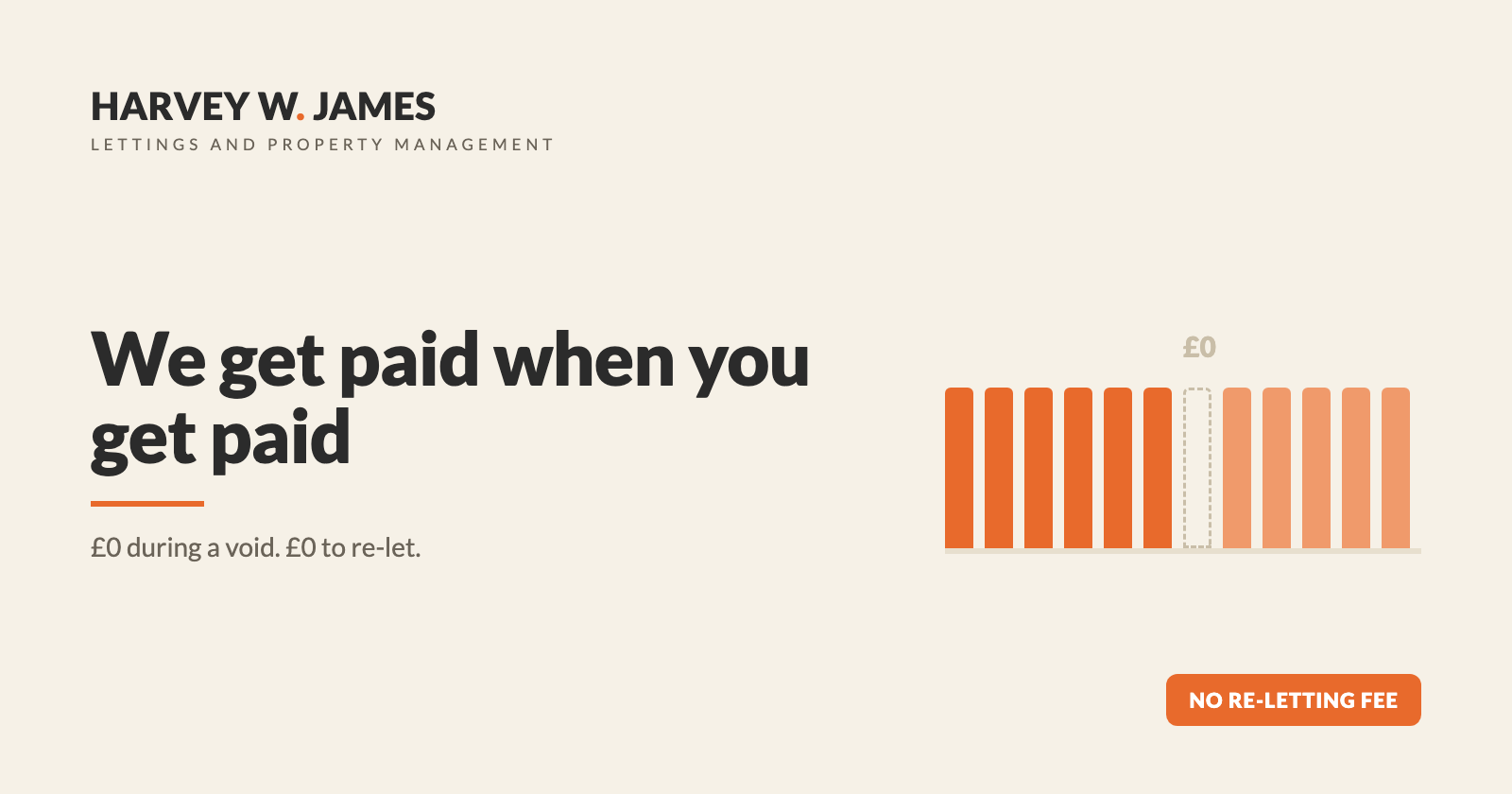
Short answer: if your tenant leaves early, you pay Harvey W James nothing more. £0 during the void. £0 to market, reference and move in the next tenant. No catch-up. Our only fee is 10% of the rent, including VAT, charged in the months a tenant is paying. No letting fee, no re-letting fee, no fee when a tenancy continues.
We have changed how we charge. This post explains what changed, what it costs you now, and why we think no large agency will follow us.
Fee terms as at 7 September 2026; the law as at 1 May 2026, when the Renters' Rights Act 2025 came into force.
What do I pay my letting agent if my tenant leaves early?
You pay for the six months your property earned. Then you stop paying.
Here is the arithmetic on a £1,000-a-month rent. The tenant gives notice in month four and vacates at the end of month six. We re-let, and the next tenant moves in at month eight.
| Month | What happens | What you pay |
|---|---|---|
| 1–6 | Tenanted | 6 × £100 = £600 |
| 7 | Void — property empty | £0 |
| 8 | New tenant moves in | £0 to re-let, then £100 |
| 8–12 | Tenanted | 5 × £100 = £500 |
| Year one | Eleven tenanted months | £1,100 |
That is the whole invoice. There is no thirteenth line.
Until now there was one. Our fee bundled a letting portion and a management portion inside the 10%, spread across each twelve-month cycle, and if a tenant left early the unrecovered part of that year's letting portion was settled once when the next tenant moved in. On the example above it came to £360. It was disclosed, it was published with the arithmetic, and no landlord was ever surprised by it.
We have removed it anyway.
Do letting agents charge a re-letting fee every time the tenant changes?
Most London agents do. A fresh tenant-find or letting fee is charged on each new tenancy, on top of the monthly percentage, and it is usually quoted as a share of the first year's rent. The field's published terms, including VAT, are set out on how we compare.
We don't. Marketing, professional photography, floor plans, the Giraffe 360 tour, accompanied viewings, Goodlord referencing, the tenancy agreement, the deposit protection and the move-in handover are all inside the 10% you are already paying. A second tenancy costs you nothing more than the first. So does a third.
That holds however often it happens, which matters more than it used to. Section 2 of the Renters' Rights Act 2025 abolished assured shorthold tenancies outright, so there are no fixed terms left to hold anyone in place. Every tenancy is an assured periodic tenancy, and every tenant can end one by giving not less than two months' written notice — section 5(1ZA)(a) of the Protection from Eviction Act 1977, inserted by section 20 of the Renters' Rights Act 2025.
Read that alongside a fee model built on re-letting charges and the problem is obvious. Tenant turnover used to be something an agent could price around. Now it is simply the weather.
Do you charge a management fee during a void period?
Nothing. We do not charge a management fee on a property that has no tenant in it, and we never have. Our 10% is calculated on rent received, not rent due, so a void month is a £0 month on your statement. That distinction is worth checking in any agent's terms: a percentage of rent due carries on through a void, and some agreements add a separate void-management charge on top.
That is not generosity, it is the incentive working correctly. Every empty week is rent you will never recover — we set out the real cost of that in void days are the landlord's money. If we were paid during a void, or paid a fee to end one, we would be paid either way. We are not. Our income stops when yours stops, and the only way we restart it is by letting your property. That is the entire alignment argument, and it only works if there is no re-letting fee sitting behind it.
What happens to the fee if the tenant leaves in month 2?
The same thing, sooner. On a £1,000-a-month rent you pay £100 for month one and £100 for month two, and then nothing until the next tenant's rent starts. The void is £0. The re-let is £0. There is no balancing charge for the months of that year the property did not earn, and no invoice that arrives because the tenancy was short.
A tenant can only leave that fast by giving notice at the start: not less than two months' written notice, under section 5(1ZA)(a) of the Protection from Eviction Act 1977, inserted by section 20 of the Renters' Rights Act 2025. So in practice you know almost as soon as the tenancy begins, and the re-let starts while the tenant is still in place.
What a month-two exit does cost you is the reports. The published one-off charges still apply because the work is still done: a check-out report for the leaving tenant (£108 to £155 by property size) and an inventory and check-in report for the next one (£125 to £175), at the prices on the landlords page and in clause 5 of our terms. Those are the only lines. We carry the marketing, the viewings and the referencing we did for a two-month tenancy. That is the deal, and a short tenancy is exactly when it matters.
Can a tenant be charged for leaving early?
If you are the tenant reading this, the rules are statutory and they are different. The Tenant Fees Act 2019 bans most payments to a landlord or agent. A payment in consideration of ending a tenancy at the tenant's request is permitted only up to the loss the landlord actually suffers, or the agent's reasonable costs — Schedule 1, paragraph 7. Since 1 May 2026 there is no fixed term to break: every private tenancy is periodic and a tenant can end it on two months' written notice, or less if the landlord has agreed in writing. What is left of the early-leave charge is set out in the government's guidance for landlords: where a tenant does not give the correct notice, the charge cannot be more than the rent the landlord would have received had the right notice been given, and a tenant-requested change to the agreement is capped at £50 unless the reasonable costs are higher and evidenced. Our own charges to tenants are published on the tenant fees schedule. If an agent asks you for a re-letting fee, ask for the arithmetic in writing before you pay anything.
Why did you drop the early-exit charge?
Because of when it landed.
The charge was largest when the tenant left earliest. A tenant leaving at month three left more of that year's letting portion unrecovered than one leaving at month nine. So the invoice was biggest in precisely the month a landlord had a void, no rent, and a re-let to fund. It was defensible arithmetic and badly timed money.
Most versions of this charge are worse than ours was. Across the London new-build specialists we track on how we compare — fee cards as at June 2026 — full management typically lands near 20% once VAT is added, and a fresh letting or set-up fee is billed on each new tenancy on top. That invoice at a re-let is not a pro-rated balance; it is a new fee at the full rate. Ours was smaller. It was still on the wrong side of the table.
We can absorb it because we are small enough to decide to. A firm with a re-letting fee line running through hundreds of branches and a set of shareholders cannot delete it in an afternoon.
What do other London agents charge when a tenant leaves early?
We are not going to put other firms' numbers in a blog post, because numbers date and a fee card can change the week after we quote it. What we can tell you is what to look for, and where the law says you must be able to find it.
Under the Consumer Rights Act 2015, every letting agent in England must publish a list of its fees on its website and on any portal it advertises on, with each fee described well enough to understand what it covers, and each amount stated inclusive of VAT — sections 83(3), 83(3C) and 83(4). That duty covers fees charged to landlords as well as to tenants (section 85), and trading standards enforce it with a penalty of up to £5,000 for a breach (section 87). So what your agent charges when a tenant leaves early should already be on their website, by law, in a document you can read tonight.
When you read it, these are the lines that appear when a tenant leaves early — the fee types, not the amounts:
- A re-letting or tenant-find fee. The letting fee charged again, at the full rate, for the replacement tenant.
- A renewal fee or renewal commission. Charged when the tenant stays past the first year — sometimes for the life of the tenancy, sometimes for years after you have moved to another agent.
- The whole term billed up front. Commission on the full first year taken on day one, with no refund if the tenant leaves at month three.
- A catch-up or early-termination recovery. The unrecovered part of a commission, invoiced when the tenancy ends early or when the next tenant moves in. This is the line we removed on 7 September 2026.
- A withdrawal or exit fee, and a mark-up on repairs, which are not early-exit charges but tend to sit in the same terms.
We have none of them. The how we compare page sets the London new-build specialists side by side, taken from each agent's own published fee card and dated so you can see when it was last checked. If we have a figure wrong, tell us and we will correct it.
Is there a renewal fee?
No, and since 1 May 2026 there is nothing to renew. Renewal fees were a charge for re-papering a fixed term when the same tenant stayed on. Section 2 of the Renters' Rights Act 2025 abolished fixed terms, so a tenancy that continues into a second year simply continues. Two things to check in any agreement written before that date: whether a renewal or continuation percentage still runs in year two, and what is now charged for serving the annual section 13 rent-increase notice, which at some agents has become a separate fee per notice. Ours is inside the 10%, and there is no continuation rate: the same 10% in year one, year two and year five.
Isn't a flat 10% more expensive over five years?
It can be, and we will say so plainly. A landlord whose tenant stays five years without a break may pay less with an agent who charges a one-off letting fee and a low ongoing management percentage. If that is your situation, the arithmetic is the arithmetic.
But an unbroken five-year tenancy is now a bet, not a plan. With fixed terms abolished and two months' notice available from day one, the landlord who changes tenant three times in five years is the ordinary case — and in central London new-build, where our book is concentrated, it is closer to the norm. Across three tenancies our number does not move. Theirs does, three times.
This is sharper again if you own from abroad. As at 24 October 2026 we manage 120 homes for 94 landlords across 36 London postcode districts, and 59 of those landlords are non-UK resident, in 9 countries. A surprise invoice is hardest to check from six thousand miles away, in a second language, against a tenancy you cannot visit. Removing the one variable charge in our model removes the one thing an overseas landlord could not predict from their own spreadsheet.
How much do London letting agents charge in 2026, and when?
The percentage is only half the question. The other half is which months, and which events, it is charged on. Here is the same year of fee events, ours against the structure of a typical London full-management agreement. The named agents, figure by figure and including VAT, are on how we compare, taken from each agent's own published fee card, and you can work out your own figure there.
| Fee event | Harvey W James | A typical London full-management agreement |
|---|---|---|
| Monthly fee while tenanted | 10% of rent, including VAT, all in | A percentage of rent, usually quoted before VAT: "12% + VAT" is 14.4% |
| A month with no tenant | £0 | Check whether the percentage is on rent due or rent received, and whether a void-management charge applies |
| Finding the next tenant | £0 | A tenant-find or letting fee on each new tenancy, commonly a share of the first year's rent |
| The tenant stays into year two | £0 extra, the same 10% | Historically a renewal fee; since 1 May 2026 look for a continuation rate instead |
| Annual section 13 rent review | Inside the 10% | Often a separate charge per notice |
| Tenant leaves early | £0, no catch-up | Varies by agreement: ask, in writing, what happens to a letting fee already charged for the term |
| Inventory, check-in, check-out | Outside the 10%, priced on the landlords page | Usually extra |
Where a figure is missing from the right-hand column, that is deliberate: the ranges published by comparison sites are wide and unattributed, and the only honest number is the one on the agent's own fee card.
What does a 10% management fee cover?
Everything we do, in any given year:
- Finding a tenant when one moves out — marketing, viewings, referencing, tenancy set-up, move-in handover
- Day-to-day management — rent collection, repairs, contractor coordination, tenant communications
- Retention work while an existing tenant stays on
- The annual rent review under section 13 of the Housing Act 1988, as amended by section 6 of the Renters' Rights Act 2025, including First-tier Tribunal preparation if the increase is challenged
- Compliance — Gas Safety, EPC tracking, EICR, smoke and CO alarm checks
- Renters' Rights Act operational compliance — PRS Database registration tracking, Ombudsman support, Awaab's Law tracking
Inventory, check-in and check-out reports and a short list of one-off services sit outside the 10%. They are published as a table with prices on the landlords page, and quoted before any work starts. If a charge is not on that table, we will not ask you for it.
And here is the line we hold. We won't send you an invoice in a month when your property earned you nothing. Not a balancing figure, not a pro-rated recovery, not a re-letting fee. If the rent stopped, so did we.
That cuts both ways, and it should. It means we carry the cost of a tenancy that ends at month three. It also means we will not put your property on the market at a rent we don't believe it will let at, because we no longer have a charge that softens the landing when it doesn't — see why we won't take the wrong price. The incentive and the promise are now the same thing.
Is this in the contract?
Yes. It is clause 4 of our Landlord Terms of Business page, not a marketing line (the Terms of Business you sign carry the same position under their own clause numbers). Clause 4.5, "Early exit by the tenant — there is no charge", sets out the four positions: the months tenanted are paid and nothing further is owed for them; no balance is carried forward, invoiced or recovered when a tenant leaves inside the first twelve months; the void costs you nothing; and marketing, viewings, referencing, tenancy set-up and move-in for the next tenant are charged at £0. Clause 4.6 is the same worked example as the table above. Clause 5 is the schedule of one-off charges that sit outside the 10%, with prices. The landlords page carries the plain-English version.
Both pages were updated on 7 September 2026, and our longer operational reference document, Essential Terms and Charges, has carried the same position since version 2.2.2 (12 September 2026), which took the catch-up, the twelve-month minimum and the exit charge out and states that no fee is due in a month with no rent. The current version is v2.5.1 (23 October 2026), and it keeps that position unchanged. The Terms of Business remain the binding agreement and the reference document is read alongside them; where anything differs, clause 4.5 is what applies and what we invoice to.
What should I ask my current agent?
Five questions, and you can ask them in one email this afternoon. Print the list and tick them off as the answers come back.
Five questions for your letting agent — from harveywjames.com
- ☐ What do I pay you in a month when the property is empty?
- ☐ What do I pay you when you find the next tenant — is there a letting, re-letting or set-up fee?
- ☐ If my tenant leaves before the year is out, is there a balancing, catch-up or early-termination charge?
- ☐ Is there a renewal fee or renewal commission when the tenant stays, and does it carry on after I leave you?
- ☐ Where is each of those published, including VAT, on your website? Please send me the page.
If the answers are not immediate and in writing, that is your answer. We publish ours: clause 4.5 of our Landlord Terms of Business, and the worked example on the landlords page. The rest of the numbers worth demanding are in the numbers every landlord should ask a letting agent for.
If you own a new-build London flat, the turnover maths above is your maths — start with new-build specialists or go straight to property management. Either way, book a free rental valuation and we will show you the working, comparable by comparable, before you decide anything.
Sources
- Renters' Rights Act 2025, section 2 (abolition of assured shorthold tenancies) — legislation.gov.uk, in force 1 May 2026 (S.I. 2026/421)
- Tenant Fees Act 2019, Schedule 1, paragraph 7 (payment on termination of a tenancy) — legislation.gov.uk
- Fees you can charge as part of a tenancy — GOV.UK, updated 7 July 2026
- How we compare: the field's published fees, including VAT, as at June 2026
- Renters' Rights Act 2025, section 20 (notices to quit by tenants under assured tenancies: timing), inserting section 5(1ZA)(a) into the Protection from Eviction Act 1977 — legislation.gov.uk
- Renters' Rights Act 2025, section 6 (statutory procedure for increases of rent), amending section 13 of the Housing Act 1988 — legislation.gov.uk
- Harvey W James Landlord Terms of Business, clause 4 (4.4–4.6) and clause 5 — harveywjames.com/terms, updated 7 September 2026
- Consumer Rights Act 2015, sections 83 (duty of letting agents to publicise fees), 85 (fees to which the duty applies) and 87 (enforcement) — legislation.gov.uk
- Harvey W James, How we compare — fee cards as at June 2026, harveywjames.com/how-we-compare
- Harvey W James portfolio statistics, /stats.json, as at 24 October 2026 (resolved from the live feed when this page is built)