
Sell or let my flat when moving abroad? The London decision before you leave
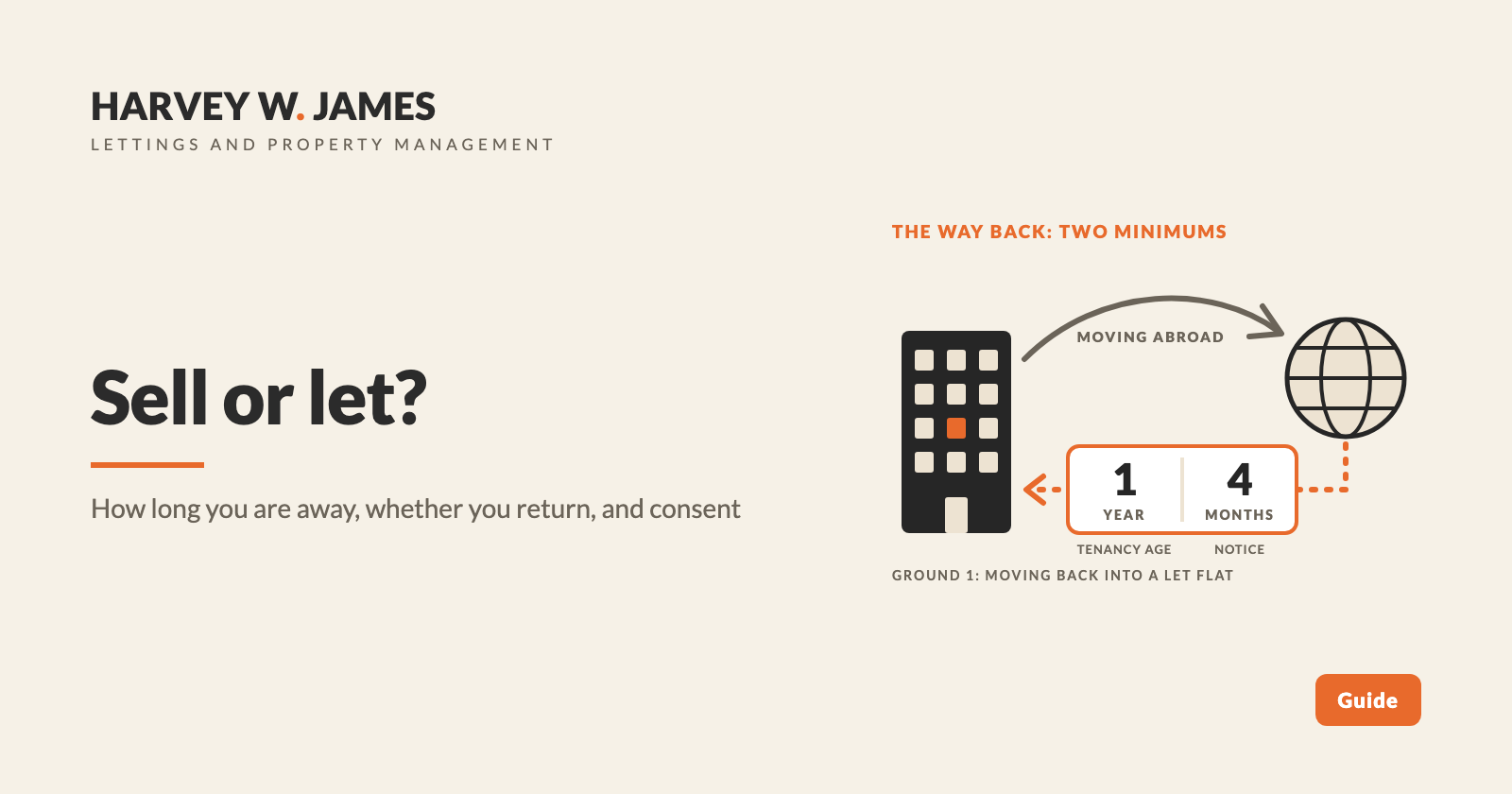
Short answer: Whether to sell or let your flat when moving abroad turns on three facts: how long you will be away, whether you will return, and whether your lender and lease allow a let. A posting under about a year may not suit letting: tenancies have no fixed end, and the moving-back ground needs a year-old tenancy and four months' notice.
We only let; we never sell. So we have an interest in one answer. This is general information as at 24 November 2026, not investment or tax advice, and it does not tell you which route is better for your money.
It is for the owner-occupier of a flat that fits our Property DNA: a modern London new-build, about 2016 or later, EPC B or better. Already left? Read letting your London flat from abroad instead.
Should I sell or let my flat when moving abroad?
It depends on your time away, your plans to return and your permissions. The facts, with no forecasts:
| Sell before you go | Let while you are away | |
|---|---|---|
| Your home when you return | Gone; you buy or rent again | Yours, but you need the tenant to leave first |
| End date | Completion | None can be written into an assured tenancy |
| Permission needed | No consent to let needed | Lender if there is a mortgage; the landlord under your lease if the lease says so |
| UK rental income | None | Taxable; non-resident landlord rules if you live abroad six months or more a year |
| Capital gains position | Private Residence Relief, if it applies, measured to the sale | Depends on the absence rules and any later sale |
| Landlord duties | None | Safety, repairs, deposit, EPC and more, wherever you live |
When does selling make more sense than letting?
The case for selling is stronger where:
- You do not expect to live there again, and you do not want to be a landlord.
- You will be back in under about a year and need this flat, not another one.
- Your lender or your lease says no to a let.
Can I move back into my flat when I return?
Yes, but not by writing "until I come home" into the agreement. Since 1 May 2026, section 4A of the Housing Act 1988 (inserted by the Renters' Rights Act 2025) makes any fixed term in an assured tenancy (the usual private let) of no effect.
Coming back usually means Ground 1 in Schedule 2. You, or a listed relative, must require the flat as an only or principal home. The tenancy must be at least one year old at the date in the notice, and the notice is at least four months (section 8(4AA)). Rely on it, and you cannot re-let or market the flat to let, with narrow exceptions, for at least 16 months from service (sections 16E, 16F and 16M). If the tenant does not leave, you need a court order.
The detail is in our Ground 1 and 1A guide. Selling later with the tenant in place needs no ground at all.
We won't promise you the date a tenant will leave.
Do I need consent to let from my lender and my lease?
The lender. GOV.UK is direct: "If you have a mortgage on the property you want to rent out, you must get permission from your mortgage lender." Two published examples:
- Santander (conditions dated July 2026) requires written permission, may charge a fee, and normally lets you keep your residential rate until that deal ends. A new deal while the flat is let would be buy-to-let.
- Skipton describes its consent as temporary, "usually for twelve months or less", adds an interest loading, and asks for the request a month ahead.
Ask in writing what happens if your consent runs out while a tenant with no end date is still there.
The lease. The NRLA says it is common for leaseholders to need permission to sublet, and suggests checking whether each new let needs it.
Where the lease allows underletting with consent, section 19(1)(a) of the Landlord and Tenant Act 1927 says consent must not be unreasonably withheld, though the landlord under your lease may ask for reasonable legal or other expenses. Under section 1 of the Landlord and Tenant Act 1988, a written application must then get a written decision within a reasonable time, with reasons if refused. A clause that simply bans underletting is different; ask a solicitor.
Do I need overseas landlord insurance?
Landlord insurance is not usually a legal requirement, Lloyds says, but the cover you rely on must be valid for a let flat. Three layers:
- The building. GOV.UK says the landlord under your lease (often the freeholder) will usually insure a leasehold building, but not the contents, through the service charge. Ask the managing agent whether letting must be declared.
- Your existing home policy. Lloyds warns that standard home insurance may not cover a property that you rent out. Santander requires your insurer's written confirmation that cover stays valid.
- Landlord cover. Lloyds says this can include your contents and fittings, and liability if you are held responsible for an injury.
Tell the insurer you will live abroad; keep the reply.
What tax should I check before I leave?
Take these to an accountant:
- Rent. Live abroad for six months or more a year and HMRC classes you as a non-resident landlord, even if you are still UK resident for tax. Your agent deducts basic-rate tax after expenses it has paid, unless HMRC approves you to receive rent in full. Our NRL explainer shows how to apply.
- Private Residence Relief. If the flat has been your only or main residence, a later gain is relieved for that time, and the last 9 months of ownership always count (Taxation of Chargeable Gains Act 1992, sections 222 and 223).
- Working abroad. Section 223(3) can treat absences as residence: up to three years for any reason, plus any period throughout which you, or a spouse or civil partner you lived with, worked in an employment or office with all its duties performed outside the UK. (A four-year allowance covers some other work absences.) The flat must have been your only or main residence before the absence, and again after it. For the work absences, the "after" condition is also met if place of work, or a reasonable condition of employment, prevented you, or that spouse or civil partner, from moving back in. That relaxation does not apply to the three-year rule. A home you rent or own meanwhile can count as another residence, and HMRC says you may then need to nominate your main residence, for which there is a time limit. GOV.UK warns that the rules differ if you are not UK resident for tax.
- Selling while non-resident. Within 60 days of completion you must report the sale to HMRC, even with no tax due, and pay any Capital Gains Tax.
We refer owners to YWC London LLP, Chartered Certified Accountants, and take no referral fee.
What changes when letting my flat while working abroad?
You become a landlord, wherever you live:
- Address. You must give the tenant an address in England and Wales for notices, or the rent is treated as not due until you do (Landlord and Tenant Act 1987, section 48).
- Paperwork. GOV.UK's list includes gas and electrical safety, an EPC, a protected deposit and a right to rent check.
- Registration. The announced PRS Database window for London is 15 July to 14 October 2027. On 24 November 2026 legislation.gov.uk still showed the regulations as a draft.
What do letting agent services for overseas landlords cover?
For us, one service: Full Management, at 10% including VAT of the rent we receive. We market the flat, run viewings and referencing, collect the rent, track certificates and coordinate repairs. Separately priced items are in our published fee schedule. Our overseas landlords page shows how it works from a distance.
Sources
- Housing Act 1988, sections 4A, 8(4AA), 16E, 16F and 16M, and Schedule 2 (Ground 1; paragraph 12), as at 24 November 2026 — section 4A · section 8 · section 16E · section 16F · section 16M · Schedule 2
- Taxation of Chargeable Gains Act 1992, sections 222 and 223, as at 24 November 2026 — section 222 · section 223
- Landlord and Tenant Act 1927, section 19 — legislation.gov.uk
- Landlord and Tenant Act 1988, section 1 — legislation.gov.uk
- Landlord and Tenant Act 1987, section 48 — legislation.gov.uk
- GOV.UK, Renting out your property: landlord responsibilities — gov.uk
- GOV.UK, Leasehold property: building insurance — gov.uk
- HMRC, Tax on your UK income if you live abroad: rental income — gov.uk
- HMRC, Tax when you sell your home: living away from your home — gov.uk
- HMRC, Capital Gains Manual CG65047 — gov.uk
- HMRC, Tell HMRC about Capital Gains Tax on UK property or land if you're not a UK resident — gov.uk
- Santander, Consent to let conditions 2026 (MORT 1131 JUL 26) — santander.co.uk
- Skipton Building Society, Consent to Let — skipton.co.uk
- NRLA, Renting out a leasehold property — nrla.org.uk
- Lloyds Bank, Landlord insurance — lloydsbank.com
- GOV.UK Housing Hub, Get ready: "Register your rental property" — housinghub.campaign.gov.uk
- The Private Rented Sector Database Regulations 2026 (draft; read 24 November 2026) — legislation.gov.uk
Moving abroad and leaning towards letting? We will give you the rent and the evidence behind it, so you can weigh it against a selling agent's figure. Book a free new-build rental appraisal.
Related reads
Letting your London flat from abroad: how the China Desk runs it end to end
Property income tax rates 2027: what landlords could pay on a London flat
Making Tax Digital is here: what the April 2026 change means for overseas landlords
Why overseas tenants pay a premium, and how full disclosure earns it honestly