
Property income tax rates 2027: what landlords could pay on a London flat
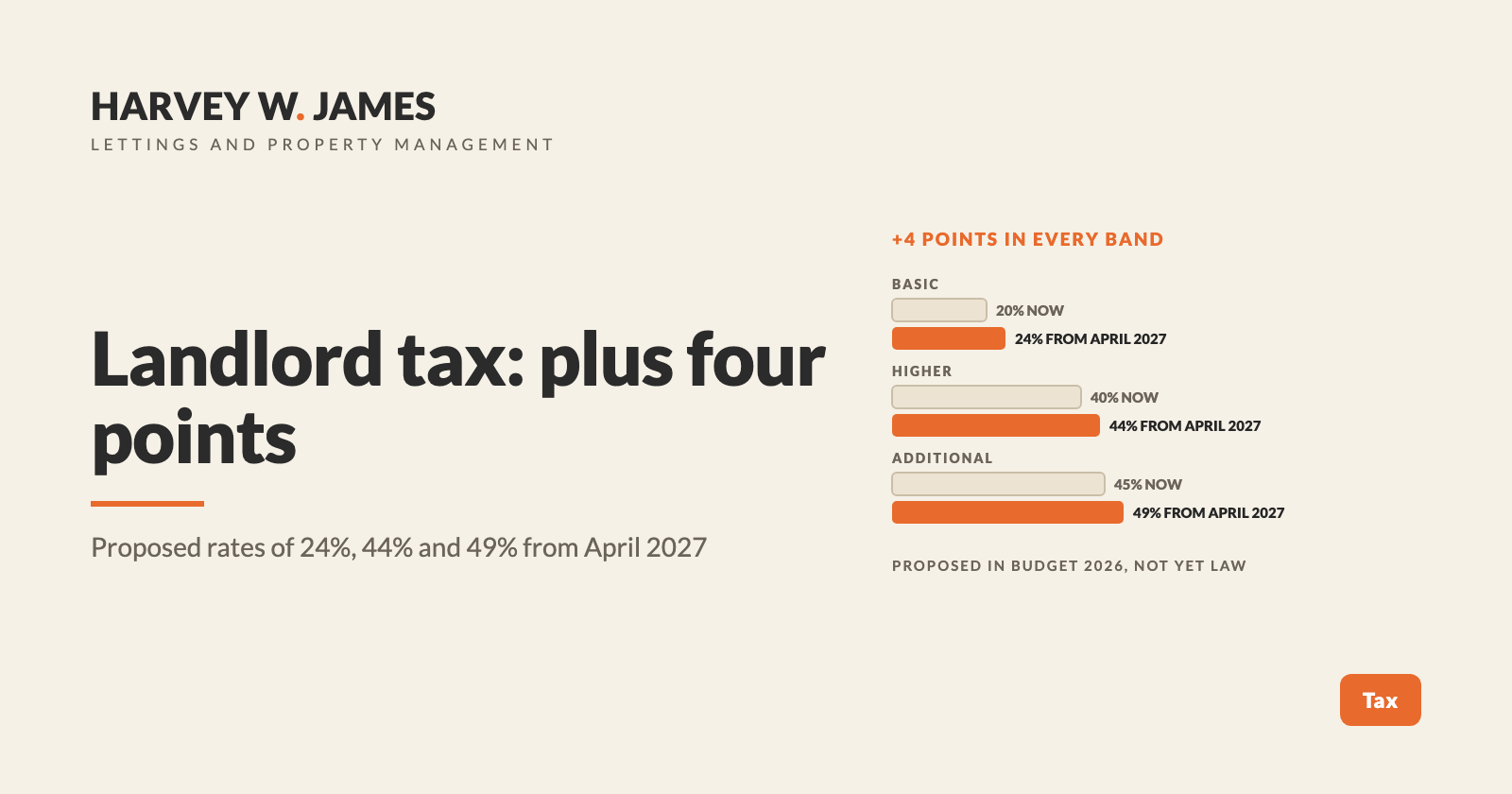
Short answer: Property income tax rates for landlords from 6 April 2027 are set to be 24% (basic), 44% (higher) and 49% (additional) in England, Wales and Northern Ireland, under Budget 2026. They sit in Finance Bill 2026-27 and are not yet law. If the Bill passes, the relief on mortgage interest moves to the same 24%.
This is a rates post, not tax advice. We read HMRC's own papers and the Finance Act 2026 on 17 November 2026, and we show the arithmetic on one illustrative London flat. How the change lands on your own return is a question for your accountant.
What are the property income tax rates for 2027-28?
Until 5 April 2027, rent is taxed at the ordinary income tax rates: 20%, 40% and 45% (GOV.UK, Income Tax rates, tax year 2026 to 2027). From 6 April 2027, property income gets rates of its own.
There have been two announcements:
| 2026-27 (now) | 2027-28, Budget 2025 (enacted) | 2027-28, Budget 2026 (proposed) | |
|---|---|---|---|
| Basic rate | 20% | 22% | 24% |
| Higher rate | 40% | 42% | 44% |
| Additional rate | 45% | 47% | 49% |
| Mortgage interest credit | 20% | 22% | 24% |
Budget 2025 created the separate property rates at 22%, 42% and 47%. Parliament enacted them in the Finance Act 2026: section 6 creates the property rates in the Income Tax Act 2007 (new sections 6D and 11CA) for 2027-28 onwards, and section 7 sets them at 22%, 42% and 47% for 2027-28.
Budget 2026, on 28 October 2026, raised them by a further two points. HMRC's tax information and impact note (29 October 2026) says legislation "will be introduced in Finance Bill 26-27" to set 24%, 44% and 49%. If the Bill passes, that is four points more than a landlord pays today, in every band.
Bands do not move. The basic rate still covers the first £37,700 of taxable income and the additional rate starts above £125,140 in both years (OOTLAR Annex A, 5 November 2026).
Is the landlord tax increase for April 2027 law yet?
Not yet. Finance Bill 2026-27 (Bill 173) was introduced in the House of Commons on 3 November 2026 (first reading). Parliament's bills service lists its second reading for 23 November 2026. Until it receives Royal Assent, the law on the statute book for 2027-28 is the 22%, 42% and 47% in section 7 of the Finance Act 2026.
We write to the 24% figures because that is the government's stated plan and the Budget 2026 rates table. If Parliament changes them, we will update this page.
Where do the new property rates apply?
For individuals, England, Wales and Northern Ireland (HMRC TIIN, 29 October 2026). The governments of Scotland and Wales have been given the ability to set their own property income rates within their existing income tax powers. Which rates apply depends on where you live, not where the flat is. If you are a Scottish or Welsh taxpayer, ask your accountant which property rates apply to you. A landlord who is not UK resident is neither, so the UK property rates apply.
What happens to the mortgage interest tax credit in 2027?
You still cannot deduct mortgage interest as an expense on a residential let. You get a tax reduction instead, worked out on the interest at a fixed rate.
Today that rate is the basic rate, 20%. The Finance Act 2026 (Schedule 1, paragraph 40) changes section 274AA of the Income Tax (Trading and Other Income) Act 2005 so the credit is given at the property basic rate from 2027-28. HMRC's Budget 2025 technical note says the same: relief "will be calculated at the property basic rate". So the credit is 22% under the enacted law, and 24% if Finance Bill 2026-27 sets the property basic rate at 24%, as HMRC says it will.
That matters. The credit rises by the same four points as the tax, so in effect the extra is charged only on profit above the interest, in every band. A higher-rate landlord still gets the credit at the property basic rate only, as now.
Worked example: a 1-bed London new-build at £2,400 a month
The figures are illustrative, not a real tenancy. We assume the landlord's other income already uses the Personal Allowance and places the whole rental profit in a single band, and we ignore the cap on the interest credit.
- Rent: £2,400 a month, £28,800 a year
- Running costs: £6,000 (including a 10% management fee of £2,880)
- Rental profit before interest: £22,800
- Mortgage interest: £9,000
| Taxpayer | 2026-27 | 2027-28 at 24/44/49 (proposed) | Extra a year |
|---|---|---|---|
| Basic rate | £4,560 − £1,800 = £2,760 | £5,472 − £2,160 = £3,312 | £552 |
| Higher rate | £9,120 − £1,800 = £7,320 | £10,032 − £2,160 = £7,872 | £552 |
| Additional rate | £10,260 − £1,800 = £8,460 | £11,172 − £2,160 = £9,012 | £552 |
The first figure in each cell is profit times the rate; the second is the interest credit. On this flat, the rise would be £552 a year, about £46 a month, in every band. That is four points on profit (£912) less four points more credit on the interest (£360). On the enacted 22% rates alone, the rise would be half that: £276.
A flat with no mortgage has no credit to offset, so the rise would be the full £912. HMRC estimates that 2.4 million landlords will face a change in tax by 2031-32.
Non-resident landlord tax rates: does this apply if I live abroad?
Yes. The UK taxes rent from UK property wherever the owner lives. The Finance Act 2026 applies the property rates to non-UK resident individuals too (Schedule 1, paragraph 9, amending section 11C of the Income Tax Act 2007). HMRC's technical note confirms that the new rates for individuals apply to non-resident landlords who file returns.
Under the Non-Resident Landlord Scheme, your letting agent (or, where there is no agent and the rent is over £100 a week, your tenant) deducts basic rate tax from the rent unless HMRC has approved you to receive it gross (GOV.UK, "Rental income" for people living abroad). HMRC's technical note says that withholding will move to the property basic rate. Whether you can claim a Personal Allowance, and how a double tax treaty interacts with your home country, is for your accountant. Our Non-Resident Landlord Scheme guide covers how the scheme works, and our Making Tax Digital guide covers the filing side.
What should a landlord do now?
Three things, before 6 April 2027:
- Ask your accountant to rerun your 2027-28 estimate at 24% and with the 24% interest credit.
- Check that the net figure still works at today's rent. The tax rates are out of your hands; your costs and voids are not.
- Keep the rent at a level the flat will actually let at. Under section 13 of the Housing Act 1988, as amended by the Renters' Rights Act 2025, a section 13 notice is now the only way to raise the rent for an existing tenant.
We won't tell you how to restructure your ownership around this change. We never give individual tax advice, and we take no referral fee for introducing a tax adviser. What we do is keep the rent, the costs and the paperwork exact, so your accountant works from true numbers.
Why this hits a Property DNA flat
The homes we manage fit our Property DNA: modern London new-builds, most owned by landlords who live outside the UK (58 of our 93 landlords with an active tenancy, Street CRM, 9 September 2026). For them, the rental profit is often the only UK income, so the property rates are the whole bill.
Sources
- HMRC, "Income Tax: changes to tax rates for property and savings income", tax information and impact note, 29 October 2026 — gov.uk
- HM Treasury, Budget 2026 Overview of Tax Legislation and Rates, paragraph 1.2, and Annex A: rates and allowances, updated 5 November 2026 — gov.uk
- HMRC, "Change to tax rates for property, savings and dividend income — technical note", 26 November 2025 — gov.uk
- Finance Act 2026, sections 6 and 7 and Schedule 1, paragraphs 9 and 40 — legislation.gov.uk (read 17 November 2026)
- Income Tax (Trading and Other Income) Act 2005, section 274AA — legislation.gov.uk
- UK Parliament, Finance Bill 2026-27 (Bill 173), stages — bills.parliament.uk
- GOV.UK, "Income Tax rates and Personal Allowances" — gov.uk
- GOV.UK, "Tax on your UK income if you live abroad: rental income" — gov.uk
- Harvey W James, Street CRM, 9 September 2026: 58 of 93 landlords with an active tenancy live outside the UK
If you own a London flat from abroad and want the numbers explained in your language, speak to the China Desk. If you want to know what your flat should let for before April 2027, book a free rental appraisal.