
Energy Independence Bill: what landlords face on EPC fines, and what hasn't changed yet
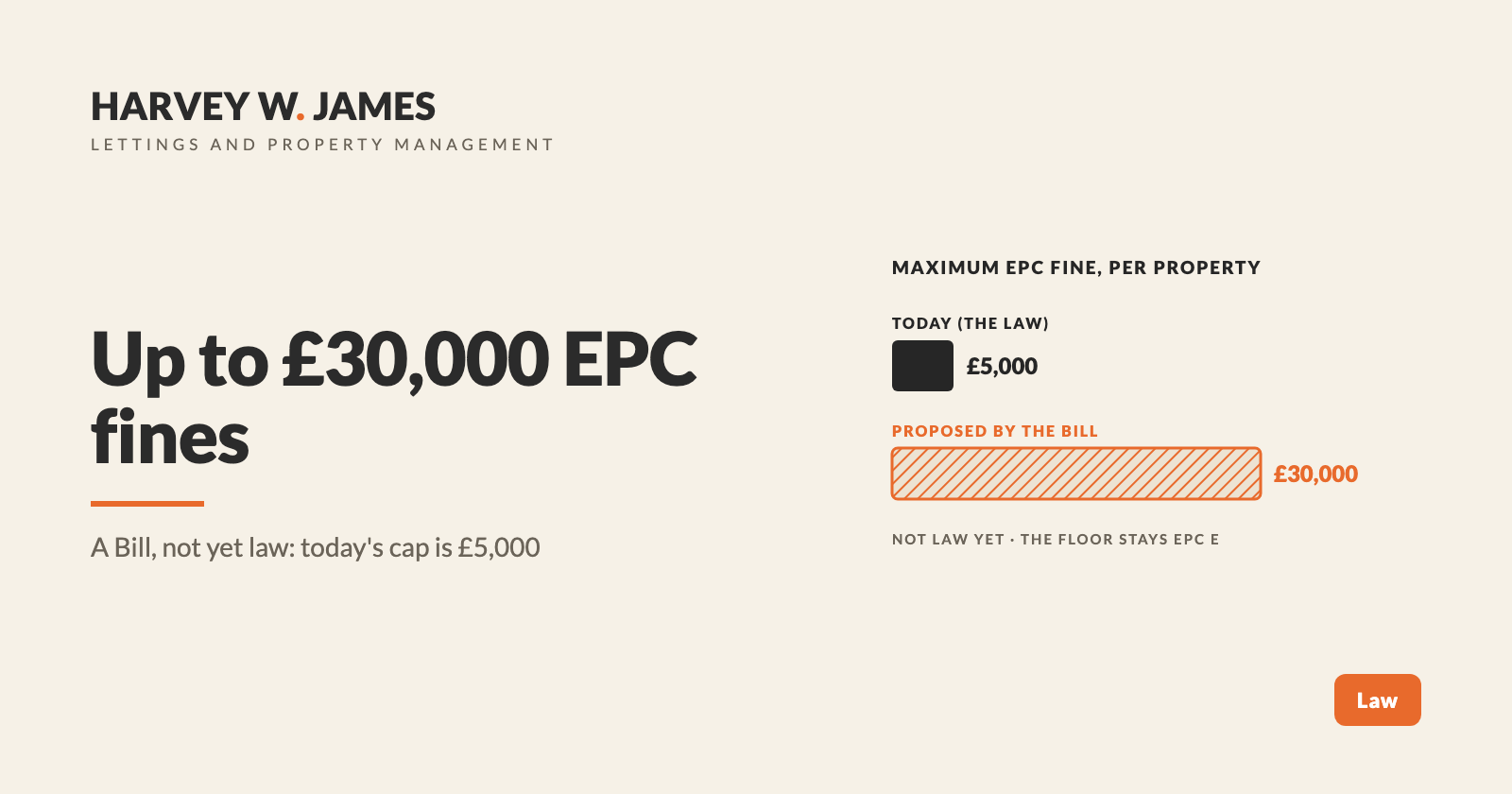
Short answer: The Energy Independence Bill would pave the way for councils to fine landlords up to £30,000 for breaching the energy efficiency rules on rented homes. Today's maximum is £5,000. As at 20 November 2026 the Bill is not law: it had its first reading in the Commons on 4 November and awaits second reading. The legal floor stays EPC E.
This is a news piece, not a rerun of our EPC C by 2030 explainer. That post covers the January 2026 decision on the 2030 standard. This one covers the Bill that would put teeth behind it, and what it does and does not change for a landlord this winter.
What does the Energy Independence Bill mean for landlords?
The Energy Independence Bill is a government Bill from the Department for Energy Security and Net Zero. Most of it is about the energy system: Ofgem, the grid, North Sea licences, heat networks. One strand is about rented homes. Its long title includes provision "about the energy efficiency of properties in the private rented sector".
As at 20 November 2026, Parliament's bills service shows:
- Bill 176 of the 2026-27 session, introduced in the House of Commons.
- First reading: 4 November 2026.
- Next stage: second reading in the Commons. No date for it is listed.
- Not an Act.
A Bill can be amended at every stage that follows, in both Houses. Everything below about the Bill describes what it would do, if passed in its current form.
What is the £30,000 EPC fine for landlords?
The government's announcement on 4 November said the Bill would give councils "stronger powers to tackle rogue landlords who fail to meet energy efficiency standards, including fines of up to £30,000". Its factsheet on domestic private rented sector enforcement says the measure would introduce "a new maximum civil penalty of £30,000" for landlords in breach of the Energy Efficiency (Private Rented Property) (England and Wales) Regulations 2015.
The reason it gives is arithmetic. The government has capped what a landlord can be required to spend to reach the 2030 standard at £10,000 per property. A £5,000 fine can cost less than the work. A £30,000 fine would not. The January 2026 government response describes the figure as a maximum "per property, per breach".
The Bill is the enabling step. The January response says the government would then lay a statutory instrument to update the 2015 Regulations, "with the aim of it coming into force in 2027", and that landlords would need to comply with the amended Regulations from 1 October 2030.
What is the MEES penalty in 2026?
Today's law is the 2015 Regulations, and they have not changed. Regulation 22 sets the "minimum level of energy efficiency" at band E. A property rated F or G is "sub-standard", and regulation 23 bars a landlord from letting it unless an exemption applies. That covers new tenancies and continuing ones.
| Today (2015 Regulations, in force) | Proposed (the Bill, then amending regulations) | |
|---|---|---|
| Lowest rating you may let at | E (reg 22) | Still E until amending regulations are made; C from 1 October 2030 is government policy |
| Letting below the floor, under 3 months | Up to £2,000 (reg 40(2)) | New maximum civil penalty of £30,000 |
| Letting below the floor, 3 months or more | Up to £4,000 (reg 40(3)) | New maximum civil penalty of £30,000 |
| False information on the exemptions register | Up to £1,000 (reg 40(4)) | Not itemised in the factsheet |
| Ignoring a council compliance notice | Up to £2,000 (reg 40(5)) | Not itemised in the factsheet |
| Total financial penalties for one breach | No more than £5,000 (reg 40(6)) | £30,000 "per property, per breach" (January 2026 response) |
| Publication of the breach | Yes, the "publication penalty" (reg 40) | Not itemised in the factsheet |
So the £30,000 figure on some sites today is a proposal. The £5,000 cap is the law.
Does the Bill bring HMOs and short lets into MEES?
It would give the government the power to. The factsheet says the measure "will ensure houses in multiple occupation can be required to comply" with the 2015 Regulations. It also includes a power to bring in homes let on a licence to occupy, such as short-term lets, but says the government "has no plans to exercise these powers at this time".
Two further points in the factsheet: councils would get better compliance information, and enforcement authorities would have to report the enforcement action they take. Expect more checks, not fewer.
Landlord EPC certificate, London: what should a new-build owner check?
The homes we take on fit our Property DNA: a modern London flat, built from about 2016, rated EPC B or better. Most of our landlords live outside the UK. For that flat, the Bill changes very little. A B is already above today's E floor and above the C the government plans for 2030. A £30,000 maximum is a problem for a landlord letting an F or G without an exemption. It is not a problem for a compliant new-build.
What does matter is the certificate itself:
- Its age. Under the 2015 Regulations, an EPC is "valid" if it was entered on the register no more than 10 years before it is relied on (reg 22(c)). A flat completed in 2016 is reaching that line now.
- Your duty at every let. The Energy Performance of Buildings (England and Wales) Regulations 2012, regulation 6, require a valid EPC to be made available free to a prospective tenant, and given to the tenant who takes the flat.
- The rating on the register, not the brochure. The rating that counts is the lodged one.
We won't sell you energy works on a flat that is already rated B. If your certificate is in date and at B, the honest answer is that there is nothing to do but renew it on time.
Landlord MEES compliance in London: what to do now
- Check the register. Confirm your current rating and the lodgement date.
- Diary the renewal. If your EPC was lodged in 2016 or 2017, book a new assessment before your next tenancy starts.
- If you hold an exemption, keep the evidence. The January response says false exemption registrations can be fined, and the Bill would mean more council scrutiny.
- If you own older stock at D or E, read our 2030 explainer and our EPC page. The 2030 cost is the real issue; the fine is the backstop.
We will update this post when the Bill moves. Until then, the law is E and £5,000.
Sources
- UK Parliament, Energy Independence Bill (Bill 176, 2026-27), bill record and stages, read 20 November 2026 — bills-api.parliament.uk · bills.parliament.uk
- DESNZ, "Energy reforms to cut bills and put power back in people's hands", 4 November 2026 — gov.uk
- DESNZ, Energy Independence Bill factsheet: Domestic Private Rental Sector Minimum Energy Efficiency Standards enforcement, 4 November 2026 — gov.uk
- DESNZ, Improving the energy performance of privately rented homes: government response, January 2026 — gov.uk
- The Energy Efficiency (Private Rented Property) (England and Wales) Regulations 2015, regulations 22, 23 and 40, as at 20 November 2026 — legislation.gov.uk
- The Energy Performance of Buildings (England and Wales) Regulations 2012, regulation 6 — legislation.gov.uk
Own a London new-build and want to know where it stands, on the rent and on the rules? We are new-build specialists. Book a free new-build rental appraisal.