
Goodlord Guarantor: how it works, who qualifies and what it costs
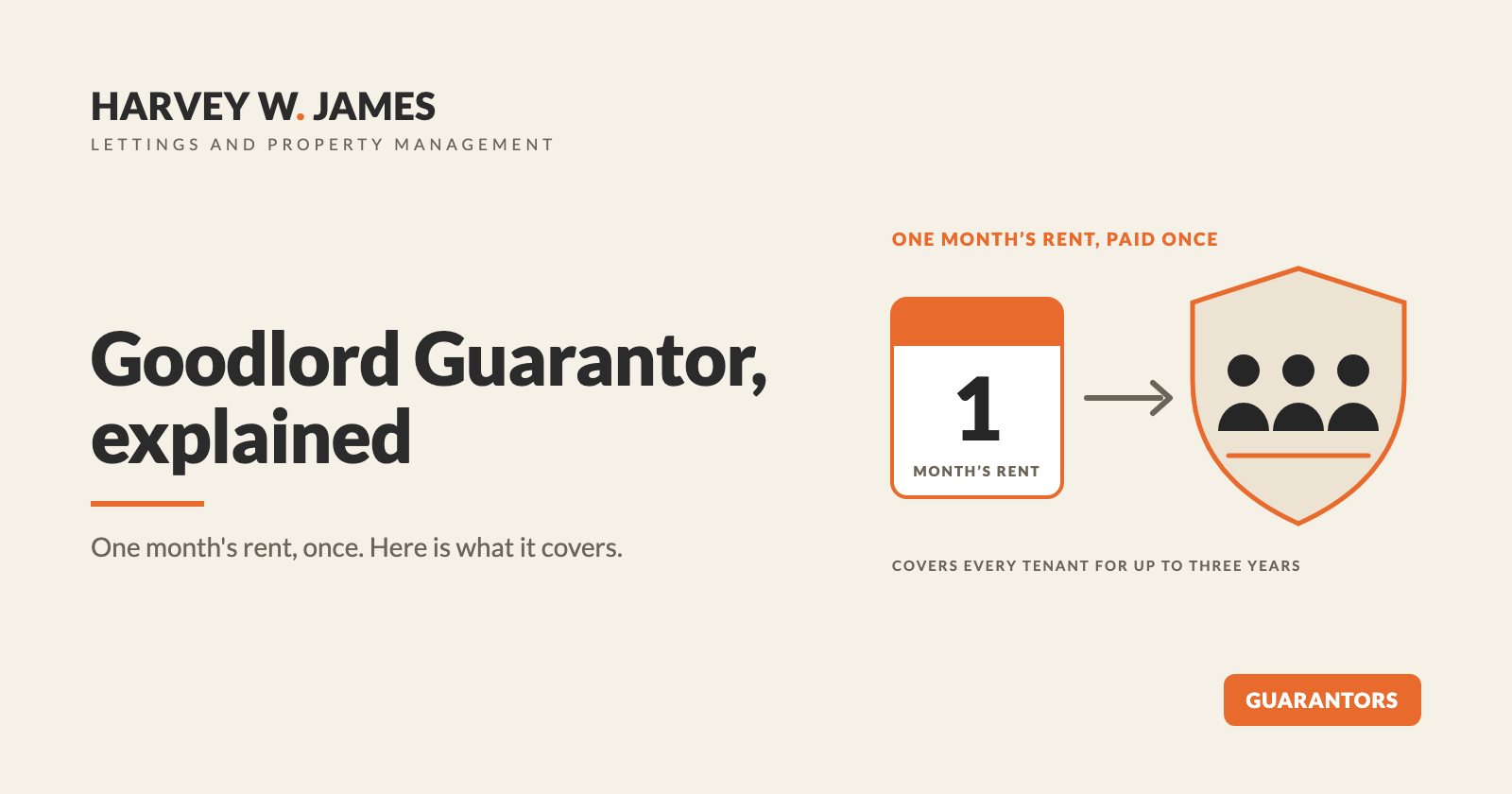
Short answer: Goodlord Guarantor is a professional guarantor sold inside Goodlord referencing. The tenant pays once, by card, a sum equal to one month's rent, and it covers every tenant on the tenancy for up to three years. It is offered only on Goodlord-referenced assured tenancies in England up to £8,000 a month, or £5,000 for students, and covers rent, not damage.
Disclosure: When one of our tenants buys Goodlord Guarantor, Goodlord pays us a share of the fee. We never require a tenant to use Goodlord Guarantor.
Goodlord sells its guarantor as the answer to the Renters' Rights Act ban on paying months of rent up front, and people now search for it by name. This article does for Goodlord what our Housing Hand guide did: it sets out the product as Goodlord describes it on its own pages, all read on 3 November 2026, and says plainly where Goodlord publishes nothing. We use Goodlord ourselves; where we stand is in the last section.
How does Goodlord Guarantor work?
You cannot buy it on your own: it appears only if your letting agent uses Goodlord and has switched it on. The sequence, per Goodlord's help centre:
- Your agent sets up the tenancy on Goodlord and you complete referencing.
- If you need a guarantor, you get an email asking you to choose one: a personal guarantor or Goodlord Guarantor.
- You see the quote, read the Goodlord Guarantor agreement, sign it, and pay by card.
- Every co-tenant is then emailed to sign the same terms. The service cannot be bought until all of them have.
- The tenancy agreement names "Goodlord Guarantor" as the guarantor.
Goodlord is explicit that it "is not an insurance product that will make your rent payments for you." It guarantees the rent to the landlord.
What does Goodlord Guarantor cost?
One payment equal to one month's rent, per tenancy, not per tenant. Goodlord's own example is a £1,000-a-month tenancy with a £1,000 fee. On a £2,400 flat the fee is £2,400; on a £4,800 four-bed student house it is £4,800 (our arithmetic on Goodlord's basis). It is paid up front and in full: Goodlord says it cannot be split across a payment plan or between tenants. UK and international cards are accepted. Card is the only payment method Goodlord's help centre gives; if your family needs another route, ask us before you apply. There are no renewal payments inside the three years.
For comparison, Housing Hand charges each applicant by rent band for twelve months; Goodlord charges the tenancy once. Which costs less depends on how many of you share and how long you stay, so price both before you commit.
Who qualifies?
Goodlord's eligibility criteria, published in its agent help centre, apply per tenancy:
| Test | What Goodlord publishes |
|---|---|
| Tenancy type | Assured tenancies in England |
| Rent cap | Up to £8,000 a month for professionals and non-students; up to £5,000 for student tenants |
| Referencing | Every tenant referenced by Goodlord on its PRO or Priority tier, with a pass, or a conditional pass where the condition is a guarantor |
| All-student households | Offered "without any earned income" |
| Mixed households | Combined household affordability of at least 2.0 |
| International tenants | Can buy without a credit record, if the 2.0 affordability test is met |
| Adverse credit | Eligible with a pass or conditional pass |
| Tenancy renewals | Offered only if the agent requests a guarantor |
Goodlord's public pages do not define the 2.0 rating; ask your agent how income is measured.
What do you still owe if rent is missed?
Everything. Goodlord's tenant help centre says that if it covers rent on your behalf, "you remain legally responsible for repaying the amount, along with any associated legal costs and interest", and that a County Court Judgment would damage your credit score. The cover is "for rent-associated arrears and costs only". Property damage is excluded. We found no maximum payout figure on any Goodlord page we read.
How does a landlord claim?
Goodlord's agent help centre sets out the process:
- A claim can be made once arrears equal two months' rent, and must be logged within 45 days of reaching that level.
- On a managed tenancy the agent claims; on a let-only tenancy the landlord claims.
- Goodlord acknowledges a claim within one working day and assesses it within four.
- It mediates with the tenant for at least 15 days, and its process includes serving Section 8 notices.
- The claim pack includes Renters' Rights Act documentation, gas safety certificates, the EPC, the EICR, deposit paperwork and the inventory.
Goodlord does not publish how quickly a validated claim is paid. The document list is the practical warning: a gap in the compliance file is a gap in the claim.
What happens if the rent or the household changes?
The cover is tied to the tenancy as set up. Goodlord's Guarantor FAQ says that if the rent amount changes, or tenants are added or removed, "the service must be cancelled" and the tenants can apply again. The same FAQ says Goodlord will cover up to a 5% rent increase across the three-year term, if the increase was made under the applicable legislation and the tenant was not already in arrears. Rent increases on an assured periodic tenancy go through section 13 of the Housing Act 1988, so a landlord planning a larger increase should check the guarantee first.
If a co-tenant leaves, Goodlord says the agreement "is no longer valid" and a new tenancy and guarantor agreement are needed. The agreement cannot move with you to a new property, there is no refund for leaving early, and at the end of three years the service stops.
Can you cancel and get a refund?
Only before move-in. Goodlord says:
- If the tenancy does not go ahead, or you do not meet the eligibility criteria, you get a full refund.
- Before you sign the tenancy agreement, ask Goodlord support to cancel; if it approves, you get a full refund within 5 to 10 working days.
- After signing but before the start date, ask your agent whether cancelling is still possible.
- Before move-in a landlord can reject the service, and the tenant is refunded in full.
- After the tenancy has started and the tenants have moved in, no refunds are given.
Can an agent make you use it?
No. Section 2(3) of the Tenant Fees Act 2019 says a letting agent "must not require" a tenant to enter into a contract with a third party for a service, and section 1(3) applies the same rule to landlords. Offering a product as an alternative to another requirement is not a requirement (s.2(6)), unless the other requirement is itself prohibited or unreasonable to expect a tenant to meet (s.2(7)). Goodlord's own rule matches: "the tenant must be allowed to choose between a personal guarantor and a Goodlord Guarantor."
Why the product exists: for assured tenancies entered into from 1 May 2026, terms making rent due in advance are "of no effect", apart from initial rent in the permitted pre-tenancy period (section 4B of the Housing Act 1988, inserted by section 8 of the Renters' Rights Act 2025). Six months up front is no longer an option.
Where we stand
We use Goodlord for referencing, Right-to-Rent checks and tenancy paperwork. Our referencing standard is annual income of at least 30 times the monthly rent, or the Goodlord Guarantor route, and for in-cap student tenancies the Goodlord route is our operational default, set out on our student lettings page. Goodlord tells agents on its own site that they can "earn a revenue share every time a tenant chooses the service". We take it: when one of our tenants buys Goodlord Guarantor, Goodlord pays us a share of the fee. You are entitled to ask any agent the same question.
We won't make Goodlord Guarantor a condition of letting to you. A personal guarantor, a university scheme or another provider is equally acceptable, and above Goodlord's caps they are the only routes. Our guarantor services comparison sets out the alternatives, and our guarantor company reviews cover how each is rated.
Sources
All read on 3 November 2026.
- Goodlord, Professional Guarantor Service (tenant page): https://www.goodlord.com/tenant-solutions/professional-guarantor-service
- Goodlord, Goodlord Guarantor (agent page): https://www.goodlord.com/goodlord-guarantor
- Goodlord Tenant Help Centre, What is Goodlord Guarantor?: https://tenanthelp.goodlord.co/s/article/what-is-Goodlord-Guarantor
- Goodlord Tenant Help Centre, How do I add Goodlord Guarantor as a tenant?: https://tenanthelp.goodlord.co/s/article/How-to-add-Goodlord-Guarantor
- Goodlord Tenant Help Centre, How do I cancel my Goodlord Guarantor service?: https://tenanthelp.goodlord.co/s/article/Cancel-Goodlord-Guarantor
- Goodlord Agent Help Centre, Goodlord Guarantor Eligibility Criteria: https://agenthelp.goodlord.co/s/article/Goodlord-Guarantor-eligibility-criteria
- Goodlord Agent Help Centre, What is Goodlord Guarantor?: https://agenthelp.goodlord.co/s/article/What-is-Goodlord-Guarantor-and-why-choose-us
- Goodlord Agent Help Centre, How do I make a claim against Goodlord Guarantor?: https://agenthelp.goodlord.co/s/article/GLGG-AG-claim
- Goodlord Agent Help Centre, Goodlord Guarantor FAQs: https://agenthelp.goodlord.co/s/article/Goodlord-Guarantor-FAQs
- Tenant Fees Act 2019, sections 1 and 2: https://www.legislation.gov.uk/ukpga/2019/4/section/1 · https://www.legislation.gov.uk/ukpga/2019/4/section/2
- Housing Act 1988, section 4B (inserted by Renters' Rights Act 2025, section 8): https://www.legislation.gov.uk/ukpga/1988/50/section/4B · https://www.legislation.gov.uk/ukpga/2025/26/section/8
- Housing Act 1988, section 13: https://www.legislation.gov.uk/ukpga/1988/50/section/13
Letting a London flat and weighing up guarantor routes for your tenants? Book a free rental appraisal.