
EN|中文
EN|中文

August best month London rental

10th March 2026
August best month London rental

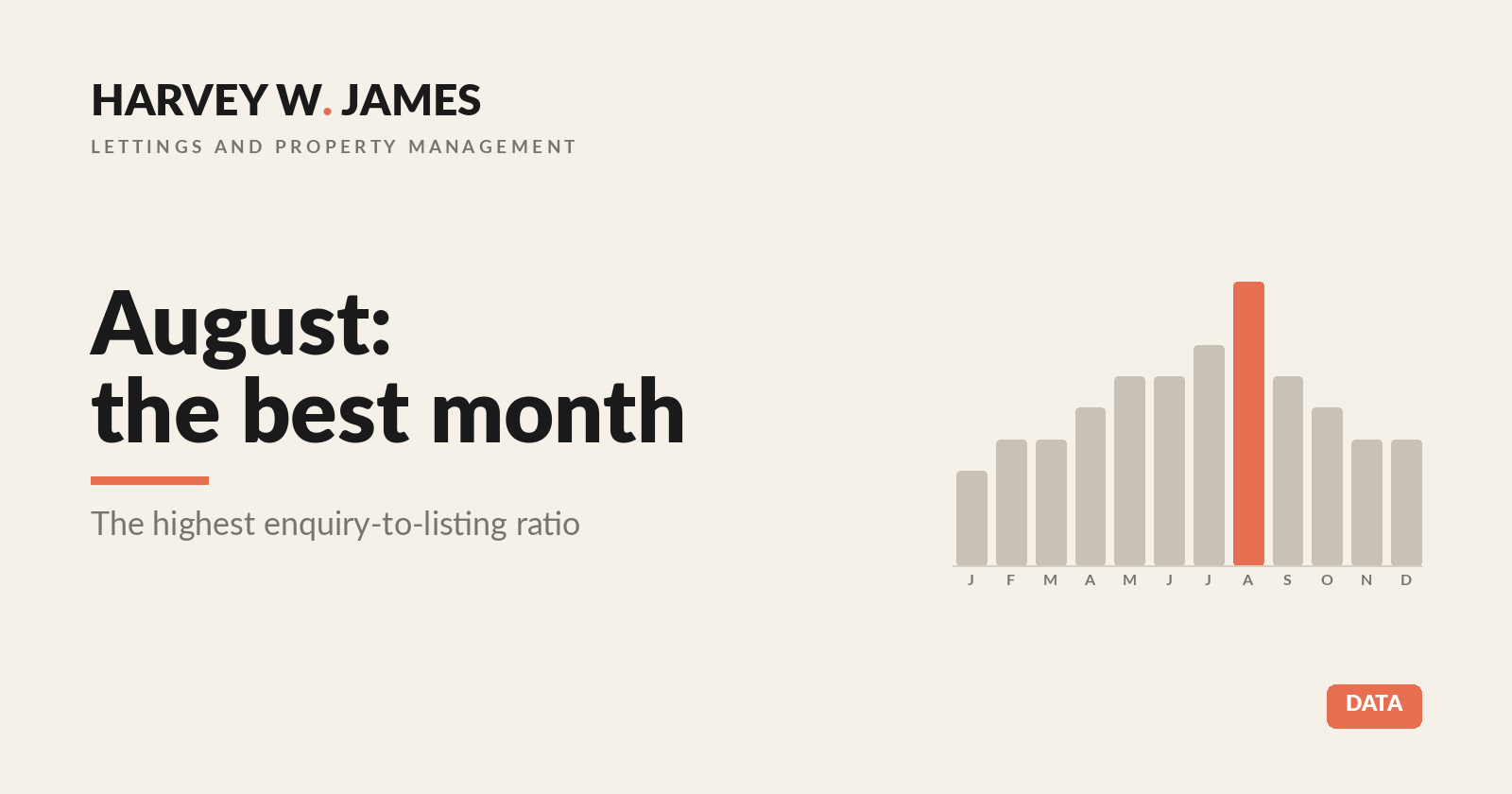
Short answer: in three years of our portfolio's Rightmove and Zoopla data, August has the highest enquiries-to-listings ratio of any month in the London rental market. More tenants are actively searching, fewer agents are listing, and a property launched at the right point in August consistently lets faster and closer to asking rent than the same property launched in November, February or May. The operational implication for a landlord is straightforward: where the calendar allows it, engineer the re-let cycle to land in August. Under the Renters' Rights Act 2025 fixed terms are gone, but the August demand peak is not, and there is a defined mechanism — the Assisted Tenancy Replacement Process — that lets you continue to time the cycle deliberately.

This post sets out what our data actually shows, why August behaves the way it does, and how a managed property can be steered back into the August window without breaching the post-RRA periodic regime.

What our data shows

Three years of listing data across our central- and east-London portfolio gives a consistent monthly pattern in the enquiries-to-listings ratio — the number of serious enquiries received per active listing in a given month. The ratio is the right metric because it controls for listing volume. A month with twice as many tenants searching is not actually a stronger market if there are also twice as many listings competing for them.

The ratio peaks in August across every year in the dataset. The supporting peak runs from late July through the first three weeks of September. October and the back half of January are the next-strongest months, but consistently below August on the per-listing measure. December and the back half of December–early January are the weakest months. May and February sit in the middle.

The drivers of the August peak are predictable. University tenancies turn over in September, so the academic search window opens in August. Corporate relocations time around the end of the summer holiday period — HR onboarding cycles cluster late August and early September. International applicants moving to London for autumn-start roles begin their search from mid-July onwards. And the supply side weakens — a sizeable share of competing landlords and small agents are away on holiday for the second half of August, which thins the listing inventory in exactly the window when applicant demand is highest.

The result is that a well-priced property advertised in early August into mid-August routinely receives multiples of the enquiry volume the same property would receive in February. We see it in the per-listing enquiry counts, and we see it in time-to-let and rent-against-asking outcomes.

Why other agents miss August

A small but instructive number of agents are still operating on instinct rather than data, and the instinct is wrong. The conventional wisdom — spring is busy, summer is dead, things pick up in September — does not survive contact with the per-listing enquiry numbers. Spring is busy in absolute terms but only because everyone is listing then; per-listing competition is high and enquiries-per-listing is mediocre. Summer is not dead. The bottom half of August is when the academic and corporate cycles intersect.

A second reason agents miss August is staffing. Pulling a competent advert together in August requires having a photographer available, an EPC bookable inside two weeks, and a viewings agent in the office. Some agencies wind down for the second half of the month and structurally cannot launch a property on time. We schedule around it deliberately.

A third reason is the landlord-side instinct to advertise as soon as the previous tenant gives notice. Under the post-RRA two-month notice regime — section 5(1ZA)(a) of the Protection from Eviction Act 1977, inserted by section 20 of the Renters' Rights Act 2025 — that instinct pushes most landlords to advertise in June, July or September. The Four Week Rule (see our analysis) explains why advertising too early throws away prime position on Rightmove and Zoopla. Combining the two errors — early advertising plus accidentally listing into a non-peak window — is the most common reason a property sits unrented for six weeks when it should have let in two.

What this means under the Renters' Rights Act

Under the previous regime a landlord could lock in a 12-month or 24-month fixed term aligned to an August re-let, and the term would naturally expire back into the August window for the next cycle. That mechanism is gone. Since 1 May 2026, all assured tenancies are periodic from day one under section 1 of the Renters' Rights Act 2025; there is no fixed term to align to.

The honest read is that the August peak now has to be engineered rather than locked in. The tenant decides when to leave (subject to the two-month statutory notice), and a landlord has no contractual lever to make a tenant stay longer or shorter than they want to. What remains is the planning lever: where the calendar allows a landlord and a tenant to agree a checkout date in August by mutual consent, the Assisted Tenancy Replacement Process exists to support that outcome cleanly.

The Assisted Tenancy Replacement Process is set out in Essential Terms §68.1 [ENDING-002-A]. It is an opt-in mechanism that we offer on managed properties where both parties agree to bring the checkout forward to a date that suits them better than the strict two-month notice end-point. Crucially it does not coerce the tenant. The tenant must positively agree to the move date, and they retain the statutory notice right if they prefer to use it. Where it works, it is the post-RRA equivalent of timing a fixed-term end-date, but consent-based rather than contractual. We have written about how the mechanism works end-to-end in our piece on engineering an August re-let.

How we plan an August re-let

For a managed property in our portfolio, the operational plan for an August re-let starts in late May or early June of the same year. The tenant communication is opened first. Has the tenant signalled an intention to move, and if so, when. If the tenant is broadly minded to move and is willing to discuss the timing, the Assisted Tenancy Replacement Process is offered as the route. If the tenant intends to stay, we plan a Section 13 rent review against the August anniversary (see our analysis of post-RRA Section 13) and the property simply continues.

Where a re-let is on, we work backwards from the available date. An August 4th availability means the advert goes live on Monday 7th July — exactly four weeks earlier, per the Four Week Rule. The photoshoot, EPC verification, floorplan and listing copy are scheduled into the preceding two weeks. Compliance certificates — gas safety, EICR, EPC — are checked against their expiry dates and renewed if they would otherwise fall mid-tenancy. The advert launches on a Monday morning whenever the calendar allows, which is the related finding we cover in our day-of-week launch post.

The discipline that holds the August timing together is refusing to advertise early. A landlord who is shown a competing agent's instruction quote for a June or July advert should ask explicitly when the advert would go live. If the answer is "as soon as you instruct", the listing will be eight or nine weeks stale by the time the August applicants are searching, and the August premium will not land on it.

Where to look next

The August finding sits inside a larger pricing and timing framework. For the central pricing thesis under the RRA, see our analysis of the day-one pricing decision. For the operational mechanism that lets a managed property hit an August window under the periodic regime, see our piece on engineering an August re-let. For the Four Week Rule that controls when in the run-up to the available date the advert publishes, see our analysis of advertising too early. For the day-of-week launch finding, see Monday morning, not Sunday. For the operational position, see Landlords.

Sources

  • Harvey W James, Lettings Valuation Guide v2.0 (RRA-aligned): Timing Appendix §1, §3; §4.1
  • Harvey W James, Essential Terms and Charges v2.1.5: §68 [ENDING-002], §68.1 [ENDING-002-A]
  • Renters' Rights Act 2025, sections 1 and 20 — legislation.gov.uk
  • Protection from Eviction Act 1977, section 5(1ZA)(a), as inserted — legislation.gov.uk

← 全部新闻

Xinf