
Best time to rent in London: the quiet months, the four-week window and the Monday morning — what our data says
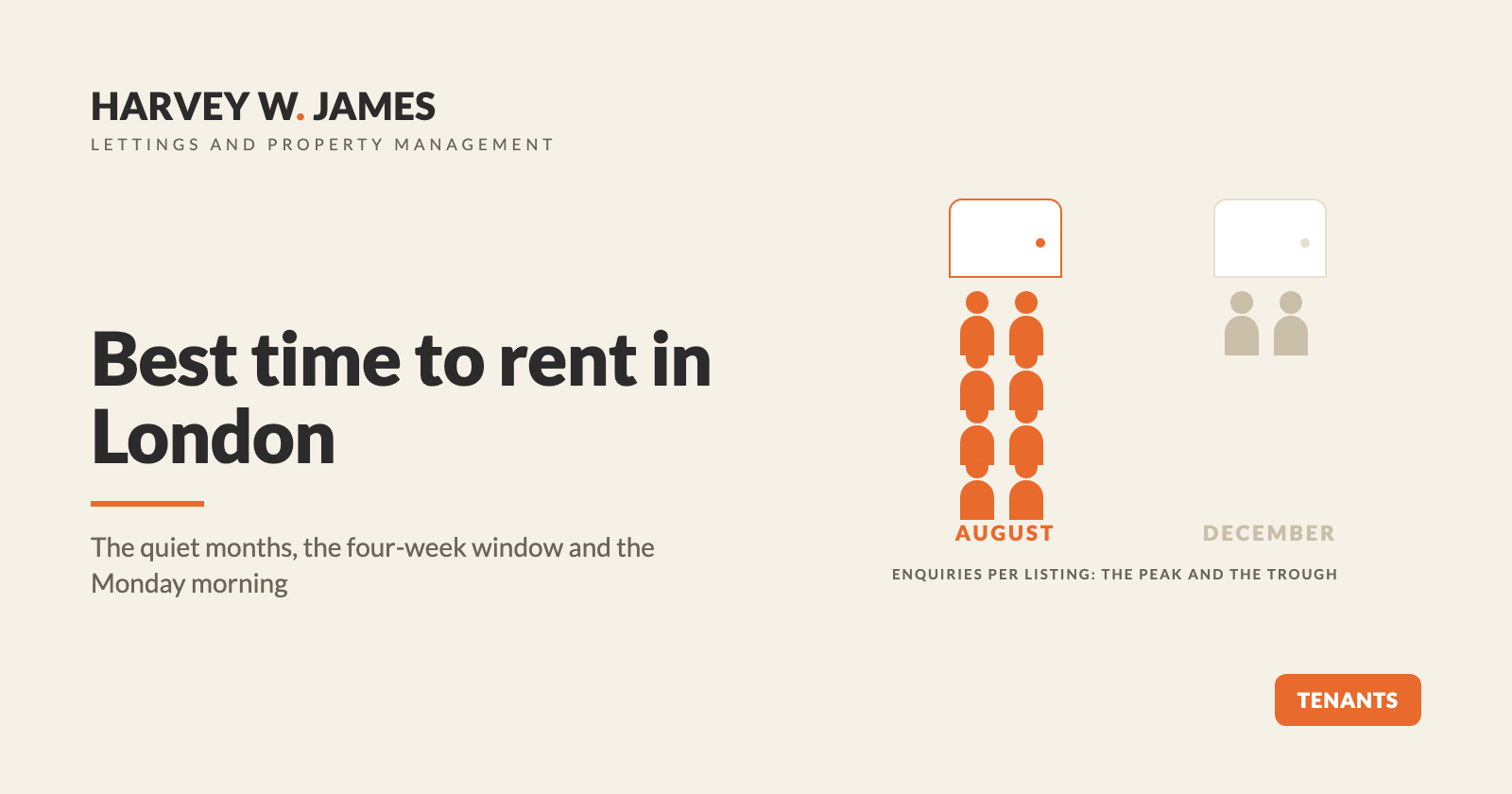
Short answer: the least competitive time to rent in London is December and the turn of the year, and the most competitive is August into the first three weeks of September — that is what three years of our own Rightmove and Zoopla data say, measured as enquiries per listing. Spring gives you the most choice but not the least competition. Whatever the month, the search that works is the one that starts about four weeks before you need to move and checks the portals on Monday morning, because that is when landlords who plan properly publish. And since 1 May 2026 you cannot buy your way past the queue: offering more than the advertised rent, or months of rent up front, is unlawful for the landlord to accept.
We publish the landlord's version of this analysis — August is the best month to advertise — because we use it to plan our clients' re-lets. This is the same data read from the other side of the door.
When is the best time of year to rent in London?
The best time of year to rent in London, if you can choose, is December to early January, when the number of people enquiring about each listing is at its lowest of the year; the worst is August to mid-September, when it is at its highest. That is the finding from our own portfolio's Rightmove and Zoopla data over three years, measured as the enquiries-to-listings ratio — the number of serious enquiries each active listing receives in a given month.
The ratio is the measure that matters to you, because it controls for how much is on the market. A month with twice as many people searching is not harder for you if there are also twice as many flats. What we see, year after year:
- August is the peak, with the supporting peak running from late July through the first three weeks of September. University tenancies turn over in September, corporate relocations cluster around the end of the summer holidays, and a share of landlords and small agents are away — so demand is highest exactly when supply is thinnest. A well-priced flat advertised in early-to-mid August routinely receives multiples of the enquiries the same flat would receive in February.
- October and the second half of January are the next-strongest months for landlords, which means the next-most-competitive for you.
- December and the turn of the year are the weakest for landlords — the fewest enquiries per listing — which makes them the quietest for you.
- February and May sit in the middle.
- Spring is busy, but per listing it is mediocre. Everyone lists in spring, so absolute enquiry numbers are high while enquiries per listing are not. For a tenant that translates as the most choice of the year at ordinary competition.
The honest trade-off is stock. The quiet months are quiet on both sides: fewer people enquiring, but fewer landlords launching, so you are choosing from a thinner list. If your dates are flexible, a December search buys you negotiating room and fewer rivals; a March-to-May search buys you choice. If your dates are fixed by a course or a job start, the month is chosen for you, and the rest of this article is about how to win inside it.
Is August really the worst month to be looking for a flat in London?
Yes, from the tenant's side, August into mid-September is the hardest window to be searching in London, because it is the month with the highest number of serious enquiries per listing in our data, every year in the dataset. It is not that nothing is available — it is that every good flat is contested.
It is also the month when a queue forms fastest. Across our managed and let-only portfolio in 2025 and 2026 to date, the median time from a correctly priced advert going live to an applicant's offer being accepted is 17 days; for one-bedroom flats inside zones 1 and 2 it is closer to 14 days, and well-priced studios and one-beds tend to receive multiple acceptable offers inside the first 10 days. In August those clocks run at the fast end. If you are a student or a September starter, the answer is not to search earlier — it is to search at the right distance from your move date, with the paperwork ready, and to check the portals when the new stock actually appears. Both are below.
When should I start looking for a flat to rent?
Start your active search about four weeks before you need to move — not eight, and not two. Most London tenants now serve two months' notice: section 5(1ZA) of the Protection from Eviction Act 1977, inserted by the Renters' Rights Act 2025, sets a tenant's notice at two months unless the landlord has agreed a shorter period in writing. Inside that period, our data shows the first four weeks are spent deciding and giving notice and the second four are the active search — which is why landlords who plan properly publish their adverts four weeks before the flat is available, our Four Week Rule.
That has three practical consequences.
- Eight weeks ahead, you are looking at the wrong flats. Anything listed now for a move-in two months away was launched too early, and the flats being launched on the Four Week Rule for your date have not been advertised yet.
- Serve notice, then search. If you are on a periodic tenancy — and since 1 May 2026 every assured tenancy is, under section 4A of the Housing Act 1988 — your notice is the trigger. Give it in writing, count two months, and begin the focused search four weeks out. Do not hand in notice on the strength of a flat you have not been offered.
- A listing's age tells you something. Rightmove and Zoopla rank by recency, and a listing cannot be re-published to reset the clock. A flat still advertised after 30 days in a normal window is, in the great majority of cases, priced above what the market will pay — that is our day-30 line, and it is the one place a polite offer below the asking rent is likely to be heard.
Which day of the week do new rental listings appear?
Monday morning, between roughly 9 and 11am, is when the largest volume of new London listings goes live, and it produces the highest first-day enquiry volume per listing of any weekday. That is the launch slot we use for every advert we publish, and it is the slot other well-run agents use too, because the portals' saved-search alert digests batch-fire in the morning window and weekend enquiries run at roughly 60% of Monday volumes. If the four-week mark lands midweek, the launch holds for the following Monday; if that Monday is a bank holiday, it moves to the Tuesday.
For you, that means:
- Set saved-search alerts on both portals for your budget, bedrooms and areas, and read them on Monday morning rather than browsing at the weekend.
- Book viewings for Monday and Tuesday. A good one-bed in zones 1–2 can have multiple offers inside ten days; by the following weekend you may be viewing something that is already under offer.
- Have the documents ready before you enquire. Proof of identity and right to rent, recent payslips or bank statements, an employer's or university's letter, a previous landlord's reference, and — if you will need one — a guarantor lined up. Our guarantor page compares the UK options if you have no UK-based guarantor.
Can I offer more than the asking rent to beat the competition?
No. Since 1 May 2026 a landlord or letting agent must advertise a specific rent and must not invite, encourage or accept an offer above it — section 56 of the Renters' Rights Act 2025, with a financial penalty of up to £7,000 under section 57 for the person who does. The advertised rent is the ceiling. That is the single biggest change to how a competitive month works: before the Act a contested flat could lawfully go to whoever offered the most; from 1 May 2026 it cannot.
Rent in advance has gone the same way. Under section 4B of the Housing Act 1988, a term requiring rent in advance is of no effect except for the initial rent due in the permitted pre-tenancy period — one rent period, which is a month at most under section 4A. Offering six months up front is no longer a lever, and under Schedule 1 paragraph 1(1A) of the Tenant Fees Act 2019 any rent paid before the tenancy is actually entered into is a prohibited payment.
So what does decide a contested flat? Speed, completeness and certainty. The applicant who enquires on Monday morning, views on Tuesday, and can produce every document and a guarantor the same day is the applicant a careful agent proceeds with — not because of any payment, but because the referencing will pass and the move-in date will hold. The money you will be asked for is fixed by statute: a holding deposit of no more than one week's rent (Schedule 1 paragraph 3 of the Tenant Fees Act 2019 — our holding-deposit guide explains the 15-day clock and when it is refunded), a tenancy deposit of no more than five weeks' rent where the annual rent is under £50,000 (paragraph 2), and the first rent period.
We publish our own operational default on all of this on the tenants page: we do not run bidding, we do not take rent in advance beyond the first period, and we will not require you to use any particular guarantor service.
Does the month I move in decide my rent for the year?
Yes, in effect: whatever rent you agree at the start is the rent for at least the first 52 weeks. Under section 13(2) of the Housing Act 1988, as amended, a landlord's rent-increase notice cannot take effect earlier than 52 weeks after the first period of the tenancy began, and it needs at least two months' notice on the prescribed form; under section 13(4) you can apply to the tribunal before the new rent is due to start, or agree a lower figure with the landlord. Our section 13 explainer sets out what the tribunal can and cannot do.
That is why the month matters twice. Signing in August, when landlords have the most enquiries and lets close nearest to the asking rent, means paying the asking rent and living with it for a year. Signing in December, when the queue is shortest, gives you the best chance of an offer below the asking rent being heard — and that rent, too, then holds for a year. For context, the Office for National Statistics put London's average private rent at £2,317 a month for July 2026 (published 19 August 2026, up 3.0% on the year) — the stock of all tenancies, not the price of a new let, which is why the figure hides more than it shows; our July rent print analysis explains the difference. The next ONS print is due on 16 September 2026.
Where to look next
Our current list is at homes to rent; every advert on it carries a specific rent that is the ceiling, and each one was launched four weeks before its available date on a Monday morning wherever the calendar allowed. Students should read student lettings for the September cycle and the university guarantor schemes. The landlord's side of the same data is in August: the best month, and the rules the desk runs on any date are in the timing engine.
Sources
- Harvey W James portfolio listing data, Rightmove and Zoopla, three years to 2026 — the monthly enquiries-to-listings series behind the August finding. The series is not published; the rules drawn from it are, in the four timing articles: The Four Week Rule (30 June 2026), Best day to launch (14 July 2026), Days on market 2026 (21 July 2026) and August: the best month (7 July 2026).
- Office for National Statistics, Private rent and house prices, UK: August 2026 (released 19 August 2026; July 2026 rent data; next release 16 September 2026): https://www.ons.gov.uk/economy/inflationandpriceindices/bulletins/privaterentandhousepricesuk/august2026
- Renters' Rights Act 2025, s.56 (requirement to state rent and to avoid rental bidding) and s.57 (financial penalties): https://www.legislation.gov.uk/ukpga/2025/26/section/56 · https://www.legislation.gov.uk/ukpga/2025/26/section/57 — both in force 1 May 2026 (S.I. 2026/421).
- Housing Act 1988, s.4A (assured tenancies to be periodic with rent period not exceeding a month) and s.4B (prohibition of rent in advance except initial rent): https://www.legislation.gov.uk/ukpga/1988/50/section/4A · https://www.legislation.gov.uk/ukpga/1988/50/section/4B — revised to 29 June 2026.
- Housing Act 1988, s.13 (increases of rent under assured periodic tenancies), as amended by the Renters' Rights Act 2025: https://www.legislation.gov.uk/ukpga/1988/50/section/13
- Protection from Eviction Act 1977, s.5(1ZA) (validity of notices to quit — tenant's notice under an assured tenancy): https://www.legislation.gov.uk/ukpga/1977/43/section/5
- Tenant Fees Act 2019, Schedule 1 (permitted payments), paras 1(1A), 2 and 3: https://www.legislation.gov.uk/ukpga/2019/4/schedule/1 — revised to 22 June 2026.
All statute text read as consolidated point-in-time data.xml from legislation.gov.uk on 13 September 2026. Our own figures are from our portfolio and are described, not audited; they are the same figures we plan our clients' lettings on.