
Days on market London rentals 2026
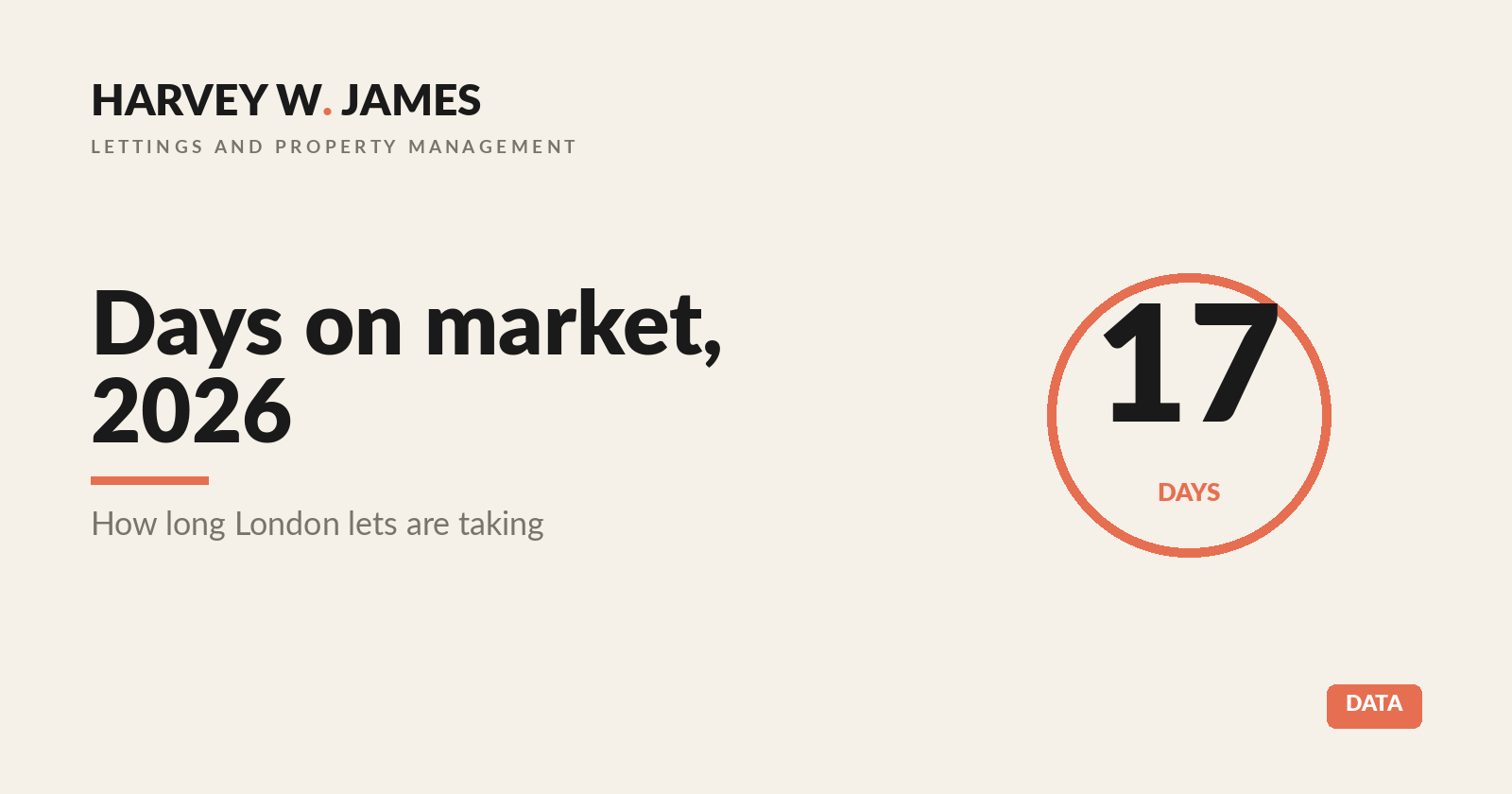
Short answer: across our central- and east-London portfolio in 2025 and 2026 to date, the median time from advert-live to applicant offer-accepted is between 14 and 19 days for a correctly-priced property launched at the right moment in the cycle. By the 30th day on market, the data shifts decisively. A property that has not received an acceptable offer by then is, in the great majority of cases, mispriced rather than under-marketed, and the next move is a pricing recalibration rather than another round of advertising spend. The 30-day threshold is the operational warning sign every landlord should know.
This post sets out the average days-on-market numbers we see by property type, the shape of the time-to-let distribution, and what we recommend when a property crosses the 30-day mark.
What the numbers look like
The headline figure across our managed and let-only portfolio is a 17-day median time-to-let for properties priced inside the supportable market range and launched on a Monday morning four weeks before the available date. The arithmetic mean sits slightly higher, at around 22 days, pulled up by a long tail of slower lets; the median is the more meaningful measure for landlord planning.
The distribution is not symmetric. The bulk of correctly-priced lets cluster between days 7 and 24. There is a smaller second peak around days 28 to 35, generally accounted for by August timing. Properties whose advert went live in early July routinely sit through three weeks of subdued summer enquiry before the August academic and corporate window opens. After day 35, the distribution flattens out into a long tail of properties that took 6, 8, 10 weeks to let. Almost none of the properties in that long tail were correctly priced when first advertised.
Breakdown by property type, in round terms:
For one-bedroom flats inside zones 1 and 2, the median is closer to 14 days. Demand consistently exceeds supply at the affordable end of the market and well-priced studios and one-beds tend to receive multiple acceptable offers inside the first 10 days. For two- and three-bedroom flats, the median is closer to 18 days. The applicant pool is smaller and more selective; matching the property to the right tenant takes slightly longer, but supportable pricing still produces a clean let inside three weeks. For four-bedroom-plus and house-share properties, the median pushes to 24 days. The applicant pool here is genuinely thin, and the dispersion in achievable rent is wider, so even a well-priced property can spend an extra week waiting for the right offer.
New-build units in central and east-London developments are a special case. The first-let of a building tends to take longer than the typical figure. The comparable evidence is sparse, applicants need to be educated about service charges, communal heating and ground rent, and the development as a whole is still being marketed. By the second and third cycle the new-build numbers normalise to the broader portfolio averages.
Why day 30 is the right warning line
The choice of 30 days as the threshold is not arbitrary. It is the point at which two independent signals converge.
The first is the recency-driven portal ranking. By day 30, the listing has slipped multiple pages back in the natural Rightmove and Zoopla feeds. The applicant who was going to find it via a saved-search alert has had the chance to do so. The applicant pool reachable by continuing to pay for the same listing is shrinking sharply, and the next two weeks of marketing will produce noticeably fewer enquiries than the first two did.
The second is the cumulative-enquiry signal. By day 30, a correctly-priced property in a normal market window has received between 40 and 80 enquiries and conducted between 8 and 20 viewings. If that volume has materialised and an offer has not yet been accepted, the cause is almost never lack of exposure. The property has been seen by a representative cross-section of the active applicant pool, and the market has communicated its view of the asking price. If the volume has not materialised, the listing has either landed in the wrong calendar window (under-pricing risk in a slack month) or the asking price is far enough out of line that the saved-search filter is excluding the property from the most relevant applicant pool.
Either way, the operational response on day 30 is the same: stop advertising at the current price, pause for 48 hours, recalibrate.
What recalibration actually means
Pricing recalibration is the operational mechanism we run when a property crosses the 30-day threshold. It is not a 2% or 5% nudge applied to keep the advert moving; it is a structured re-pricing decision based on the same comparable-rental methodology we used to set the original asking price, refreshed against the comparable evidence the 30 days of marketing has produced.
The inputs to a recalibration are the enquiry-to-viewing conversion rate (low = price too high to filter past the saved-search threshold), the viewing-to-offer conversion rate (low = price too high relative to the in-person assessment of the property), the volume and quality of offers actually received (one low offer is a signal; a cluster of offers at a specific lower figure is a verdict), and the comparable lets that have completed in the surrounding postcode area during the same 30 days. We weight the comparable lets more heavily than the comparable listings. What other properties have actually achieved in cleared transactions is materially more useful than what other landlords are still asking.
Where the data supports it, a single decisive recalibration is the right move. A 5% reduction will recover prime position on Rightmove via the price-drop sticker, will widen the saved-search filter results, and will signal to the watching applicant pool that the listing is now serious. Repeated 1% to 2% reductions over multiple weeks do the opposite. They signal a landlord who is testing the market rather than meeting it, and applicants will frequently wait for the next reduction rather than offer at the current figure.
The decision is the landlord's, not ours. Our job is to set out the evidence and explain what each option produces. The position we will not take is the comforting one — "let's give it another two weeks at the same price and see what happens" — because the data tells us what will happen, and another two weeks rarely produces a different outcome.
Where to look next
Days-on-market sits inside a wider pricing and timing framework. For why getting the asking price right at the start matters disproportionately under the RRA, see our analysis of the day-one pricing decision. For why we won't take instructions at the wrong price in the first place, see the brave-position piece. For the timing decisions that produce the days-on-market figures cited here, see the Four Week Rule, August is the best month and Monday morning launch. For the operational position, see Landlords. And for the figure on your own flat, priced from the data above, book a free rental valuation — no obligation.
Sources
- Harvey W James, Lettings Valuation Guide v2.0 (RRA-aligned): §5.1, §5.2, §5.4.2; Timing Appendix
- Three years of portfolio Rightmove and Zoopla listing data (2024–2026, central and east London)