Inside our Giraffe 360 capture
Inside our Giraffe 360 capture
Short answer
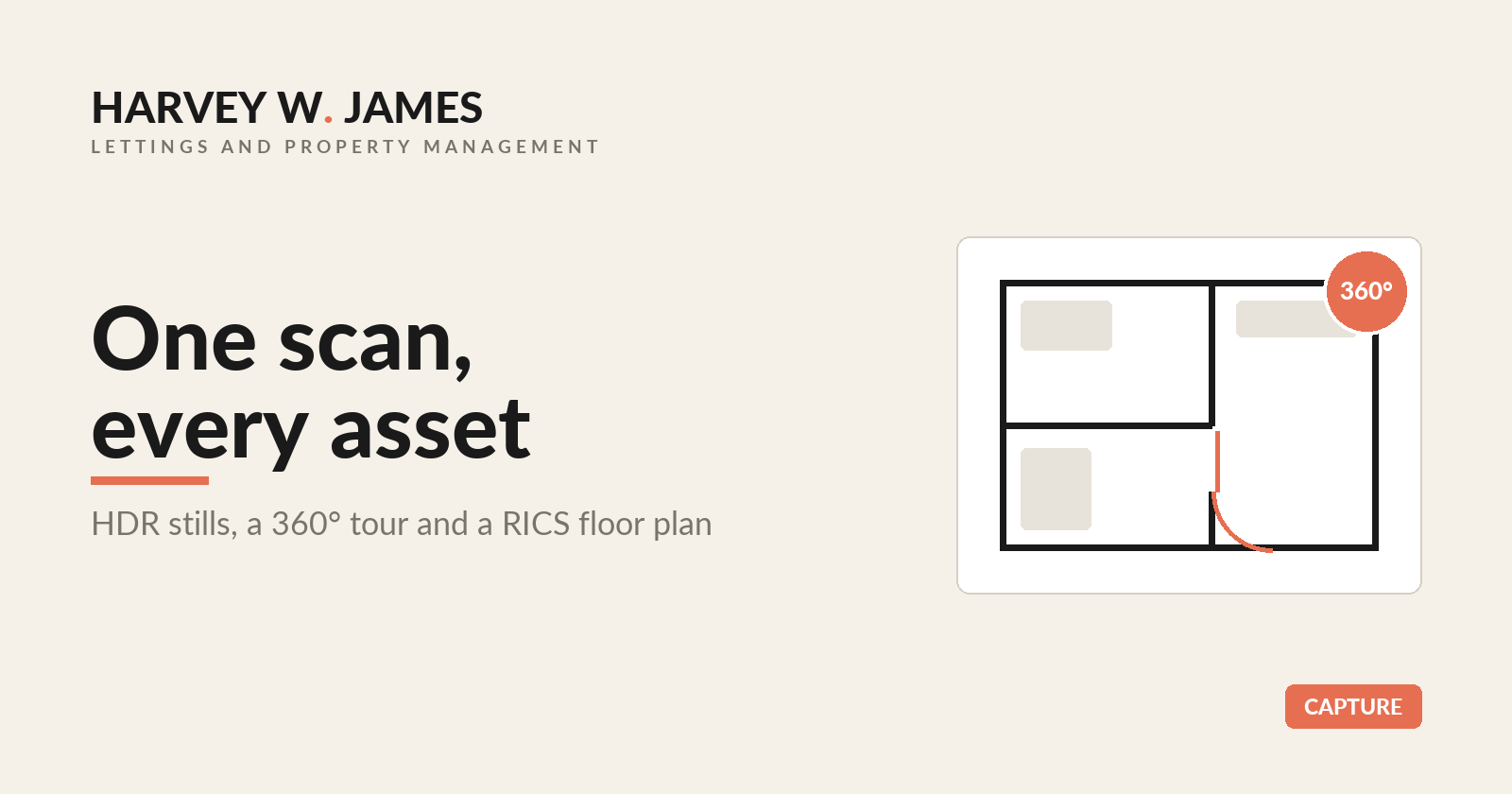
A property virtual tour and a laser floor plan come from a single scan of the property using a Giraffe 360 capture system, which produces HDR photography, a high-resolution 360 tour, a measured floor plan and video all at once. The floor plan is generated from laser measurements rather than drawn by hand, and the tour carries a measurement tool and a rotating mini-map. The reason it matters is behavioural, not cosmetic: it lets an applicant study a property in full and offer on it before they have ever stood inside.
This is one of four posts under The Marketing Engine, the full account of how Harvey W James lets faster, at the full market rent. This one opens up the capture system itself — what each piece is, how it is made, and where we draw the honesty line.
It is one scan, not a camera
Giraffe 360 is not a camera in the old sense. It is a complete capture system, and from a single scan of the property it produces the entire media set — HDR stills, a 360 virtual tour, an accurate floor plan and video — in one pass. That matters for a reason this whole series keeps coming back to: a single property visit becomes the whole advert, the assets come back fast, and speed to market is the biggest lever there is on void days. The case for owning that pipeline rather than renting it is made in full in why we shoot, edit and write every advert in-house.
Here is what each piece of the scan actually does.
LiDAR laser scanning. The system uses laser (LiDAR) technology, collecting hundreds of thousands of data points per second to build a true-scale, millimetre-aware understanding of the space. Everything downstream is accurate rather than approximate because it is built on measured data, not estimates.
HDR photography. It captures high-resolution HDR stills. HDR — high dynamic range — means the camera takes several exposures and blends them, so you get a bright, properly lit room and a clear view through the window in the same shot. That is precisely the photograph most cameras fail: a beautiful living room with a blown-out white rectangle where the window should be. On a home at the top of the London market, the view out of the window is part of what is being let, so a balanced exposure that keeps both the room and the window is not a nicety — it is part of the product.
The floor plan, generated from the scan. Because the plan is generated from the laser measurements rather than sketched by hand, it is accurate and it comes out of the same scan automatically. Doors, staircases and pillars are picked up and placed properly. Our floor plans are produced to the RICS IPMS 3C measurement standard — the recognised international standard for measuring residential space — so the dimensions are not a rough guide, they are a measurement someone can rely on.
The high-resolution 360 tour. The tour is stitched automatically from the scan, with no manual editing, and it is extremely high resolution, so a viewer can move through the property and genuinely study it rather than glance at it.
Built-in measurements and a rotating mini-map. The tour carries a measurement tool, so a viewer can check a dimension themselves, and an integrated floor-plan mini-map that rotates as they look around, so they always know where they are standing in the property. Those two features are what turn a tour from a nice walkthrough into a tool someone can actually decide on.
Video, from the same scan. The same capture produces a video, giving the applicant another way to experience the home.
Why this matters under the Renters' Rights Act 2025
This is not only a marketing point — it is a pricing point, and under the Renters' Rights Act 2025 the two are now the same thing.
Under the Act, the rent set on day one is, in practical terms, the rent for the life of the tenancy. Bidding above the asking rent is banned, so the advertised figure is a ceiling, not an opening bid, and the usual ways of correcting a weak launch later are gone. So the advert has to achieve the full market rent at the first attempt, and then defend it — there is no quiet upward correction in month three.
A complete capture is how the advert defends the rent. When an applicant can measure a room themselves, see a true-scale floor plan, walk the property in a high-resolution tour and check the storage and the window views, there is nothing left to haggle down. Doubt is what gets a rent negotiated downward, and a full Giraffe 360 capture is built to remove the doubt before the conversation starts. The pricing half of this is covered in the overseas-tenants post; the detail half — the appliances and building systems we publish alongside the tour — is in the appliance specifications post.
How Harvey W James does it — and where we stop
The platform can do more than capture. It can do blue-sky replacement, object removal and privacy blurring, and it can also do AI staging — dropping furniture into an empty room. We use the honest tools and we deliberately stop short of the rest.
Blue-sky replacement, object removal and privacy blurring are housekeeping. They make a true picture read cleanly without changing what is there. We use them.
AI staging is different, and for a rental we will not use it. The reason is the line this whole firm is built on: what an applicant sees has to be what they get. If we staged an unfurnished property with AI furniture, an applicant deciding from the images alone might believe that furniture is included, sign, arrive, and find it was never there. That is the exact moment a tenant feels they were sold a lie, and we would rather lose the embellishment than risk the trust. So our tours and stills show the property as it actually is — measured, lit honestly, and never furnished with things that will not be in it. The full argument for that discipline, and why owning the editing is what makes it safe, is in why we shoot, edit and write every advert in-house.
What this means for your property
The reason this is worth doing is not vanity, it is enquiries and offers, and there is published research behind it.
According to Giraffe 360's own research, virtual tours can lift enquiries by around 130% and listing engagement by around 45%. Those are Giraffe 360's figures for their own product, and we cite them as theirs — more people enquire, and the people who do engage with the listing more deeply.
The figure that matters most, though, is about behaviour at the point of decision. Redfin found that 63% of recent buyers made an offer on a home they had only seen virtually, sight-unseen. That is the whole thesis of our marketing in one number: with a complete enough picture, a serious applicant will commit to a property before they have set foot in it. For a London letting agency taking enquiries from applicants in other time zones, who may never fly in before they sign, that is not a curiosity — it is the entire reason the capture exists. The audience that benefits most from it is the subject of why overseas tenants pay a premium.
For a landlord, the practical result is this. The property is shown at a standard a private landlord cannot easily commission. The floor plan is a real measurement, not a sketch. The tour is a tool an applicant can study, not a slideshow they skim. The pictures are honest, so the applicant who offered on them is not disappointed at the door. And the whole capture is built to do one job: achieve the full market rent on day one and give the applicant every reason to say yes before they have stood in the room — which, under the Renters' Rights Act, is the moment that decides the rent for years.
The rest of how this fits together — the in-house ownership that makes it fast, the appliance detail that goes alongside it, and the overseas applicant it is built for — is in The Marketing Engine.
Sources
- Virtual tours lift enquiries by around 130% and listing engagement by around 45% (Giraffe 360's own research, cited as theirs): Giraffe 360 — virtual tours.
- 63% of recent buyers made an offer on a home they had only seen virtually, sight-unseen: Redfin — remote homebuying surges to a new high (2020).